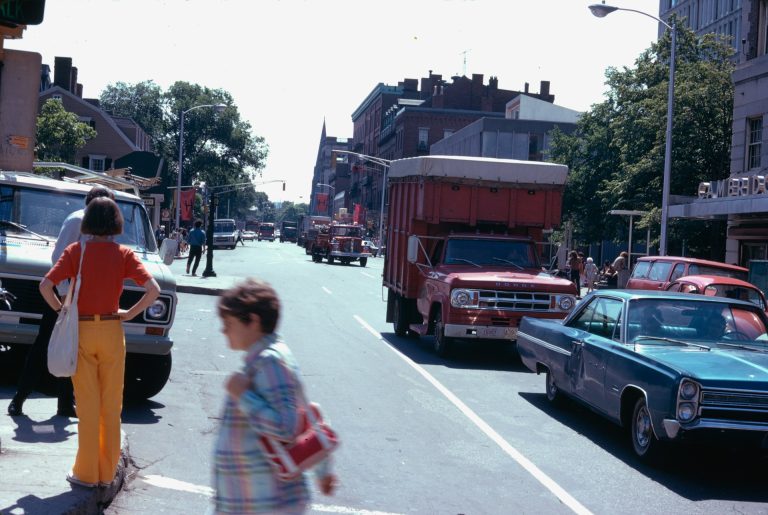
That first year in Cambridge with the junkies in the hall and no heat because your mother could only pay 90 dollars a month instead of the 110 the landlord wanted (unless she was willing to do what the neighbor who took in foster kids for cash did) where you boiled water on the stove to take a bath because there was no law in those days about providing heat to tenants, even with a wind chill of minus twenty. Back then there seemed to be no laws at all, at least not on River Street, where dogs roamed free and ready to bite, kids threw bricks at you on the way to school (Cambridge in 1971 was a far cry from the leafy suburbs of Alexandria that you left behind, along with your cats and friends and little red satin beanie that you wore to chapel every morning at Grace Church Episcopal), but God there was music! Everywhere you went, guitars and bass and drums pouring out of transistor radios and laundromats and cars, bands with funny names like Cream and Strawberry Alarm Clock and Sly and the Family Stone, music that seemed to be written for these streets, and for you, lifting your feet up off the bumpy brick sidewalks covered with gray snow, giving you the sky again, and promising springtime even if there wasn’t a leaf in sight. Music playing while you and your sister walked across town to grocery stores where no one knew you so you could use food stamps to buy bread and mayonnaise and cans of tuna, anything to wash away the taste of the government powdered milk and greasy peanut butter that came in giant metal tubs — and there was other music too, songs about peace and justice at the church near Harvard Square where you went for the free breakfast after sermons about Honeywell and Monsanto and Agent Orange, and music at home, your mother’s much younger boyfriend playing harmonica to rickety old songs on the hi-fi (the only piece of furniture she took with you when you left Alexandria other than the silver Tiffany baby cups and some photos of Granny and your father and a world you’d known briefly but was now swallowed up for good), music from the blues bar across the street where your mother went to sketch and left you and your sister to huddle behind the police lock and make up stories about a rich relative saving you. There was an Aunt Betty, your father’s sister, who lived in a big house in Milton, where maybe you could have a bedroom with furniture that hadn’t been donated or found on the street — but usually you were too busy in the music of your mother’s life to think about other places, following her to free concerts at Dunster House or free cocktail parties at the School of Design or free movies at the law school, free, free, free; she felt free for the first time in her life (50 years later she will tell you this just before she dies) so even if you were scared half the time, you were happy the other half because your mother was.
You only saw Aunt Betty once, when your mother dragged you to her famous jewelry store on Newbury Street in Boston — she was behind the counter, decorated with the pearls and ribbons your mother had traded in for art, sex, and music, and she took one look at you, dressed like a mini Mick Jagger in your bell bottoms and dirty sheepskin coat from Goodwill, and called you a ragamuffin, a lost cause, and turned away from you forever (forgetting she was once a girl in Paris in love with a sax player before she became another object under glass), and you rode home on the T, laughing with your sister at “No assing rough” because someone had scraped off the letters to “No Passing Through,” until the train spat you out into the hippie heaven of Harvard Square with the peaceniks and guitar players and weirdos who your mother had pledged allegiance to instead of the war machines her admiral father helped build, and you were home.
How could Aunt Betty know, how could anyone know, that the music you first heard on the streets of Cambridge from the radios and blues bar and harmonica of your mother’s boyfriend, would live in your body alongside the junkies and the no heat and the police lock and the greasy peanut butter and sheepskin coat, and one day burst through you on stage playing bass guitar in a rock band, mini Mick Jagger made real, blooming out of the dead soil of Monsanto and bad landlords and dead admirals and a father who never sent child support and the WASP relatives who never once came to see you, to check if you were eating, or breathing, if you were scared being alone in an apartment with junkies sleeping in the hall. And for the rest of your life you will be afraid of the dark and make terrible choices about men but you won’t be afraid to go on stage and sing to strangers because you’ve seen death up close and it looked like Aunt Betty, and you chose life, your mother’s life, where anything could happen, anything could bloom, even out of dead soil, just like the forsythia after that first winter in Cambridge when your mother taught you the word and you rolled it on your tongue, walking with her to the Orson Welles cinema to get the free apple cider and brown bread before a movie, marching to a tune you made up as you went along — far, far, far, from the people who were supposed to love you, who cut you off but set you free.
Image by Boston Public Library on unsplash.com, licensed under CC 2.0.
- Background Music - December 2, 2025
So painful and yet so amazing. Thank you so much for sharing
Thanks for sharing your brave, beautiful soul with the world.
I just loved the energy of this …full of such childlike bon vivant. As a Brit I only know Harvard Square as an adult who lived in MA for three years . How times have changed. I’m not sure how many mini Mick Jaggers ride the T today with a belly full of aluminium peanut butter. Bravo! Would love to read this book.
This essay is lyrics and music for the soul. Thanks for sharing!
Whoa. Powerful. I love the rhythm and the redemption.
Love this piece of writing. Opens up a vibrant, sad world with music the blood supply running through its veins. I would read the memoir
Thank you all so much for reading and for your kind words about the piece! I really appreciate it.
Thanks so much for publishing this vibrant, thrumming piece. Poetry!
Vivid, evocative storytelling. We want to know more about this kid! Rock on!
Music touches us all in various ways at various times. Thanks for posting. Bob