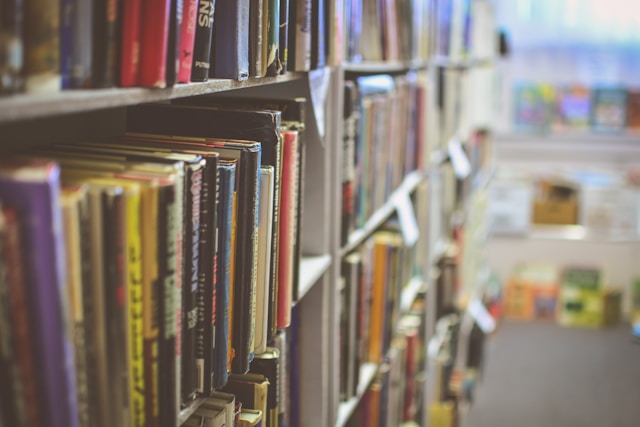
Yesterday I took my curly-headed three-year-old to our local library. She picked out a book about a ballet-dancing panda, and while waiting to checkout, said, “We have to pay!” I smiled and said, “No. You don’t pay at the library. We all share the books.” I almost added “for now,” but couldn’t. How do you tell a toddler who just checked out her first book that one day this could all be gone?
On March 14th, the Trump administration issued an executive order to gut the Institute of Museum and Library Services (IMLS) and put its staff on administrative leave two weeks later. They rescinded IMLS grants around the country, like Washington state’s $3.9 million that supports rural libraries and funds Talking Books and braille programs that create audiobooks for the blind.
Established in 1996, the IMLS is non-partisan and the only federal agency dedicated to supporting America’s museums and libraries. Because they fund critical research and community programs in all fifty states, attacking the IMLS is attacking libraries. Only .0004% of the federal budget went to the IMLS in 2024. That is 87 cents per American each year.
The Deputy Secretary of Labor and acting IMLS Director, Keith E. Sonderling, said he is committed to “enhanc[ing] efficiency” at the IMLS, but these cuts aren’t about efficiency. Efficiency is a red herring for the administration’s disdain for what institutions like libraries do. Simply put, libraries are economic levelers. They, more than any other American institution, are governed by the logic of sharing. When we share space and things in libraries, social class recedes into the background in small but meaningful ways. It’s this — the dulling of class-based inequality — that the administration is trying to snuff out.
***
People have origin stories about places they love. Mine is less about a particular library and more about the role they’ve played in my life. As a teenager in the mid 1990’s, I’d bike to the library in the 98-degree Florida heat, willing myself to pedal by imagining the moment I’d step inside. Sliding glass doors would open to frosty air that slowed my breathing and settled my heart rate. Twenty minutes in, my sweat-soaked shirt turned cold, and I’d shiver in the corner, hunched over a pile of books. Fanning them out into small arcs on the floor turned colorful covers into mini rainbows. Children flipped through picture books and old men read the paper. Missing a mom who’d left my little brother and me was replaced by the comfort of sharing space with people absorbed in their own worlds. I could pick any books I wanted, limited only by how many I could fit in my backpack before busting the seams.
Twenty years later, far above the Mason-Dixion, I rode my bike to another library. I had moved to Boston for graduate school and was working on a doctorate in anthropology. The Boston Public Library (BPL) was a winding 6-mile ride from my house. I’d park my bike near its original entrance (erected in 1895) so I could walk past the two seven-foot-tall bronze “Sisters of Literature” sculptures. “Art” holds a paintbrush and palette and “Science,” a globe. I’d send up a little prayer to Science as I passed her, get coffee, and climb the stairs to the third floor.
My favorite spot at the BPL is red. The carpets, walls, shelves, and even the ceiling are red. The color is frenetic, yet the space is calm. It has armchairs and the room’s focal point is an arched floor to ceiling window that runs the length of one wall and overlooks the city. Graduate school, where everyone tells you to “just write” (but no one tells you how) was isolating. And the fertility treatments I was undergoing at the time left me with a vague sense of hopelessness. It sounds strange, but the wide, empty tables were what I liked most. Facing the window, I’d highlight articles and scribble outlines. I didn’t know when I’d finish the dissertation or if the fertility treatments would take, but getting lost in the quiet order, surrounded by what felt like every idea humanity has ever had (the BPL has 23 million items), got me through. For me, libraries are places that can hold a heart. For others, they’re more.
***
Improving the “efficiency” of the IMLS, and by extension libraries, sounds positive in the abstract. However, the Department of Government Efficiency’s (DOGE) slash and burn approach to public institutions has left many asking whether inefficiency was the point. Fewer people using fewer services makes it easier to justify cutting them and giving tax breaks to the wealthy.
Efficiency is an even flimsier justification when we consider the societal role that American libraries have played over the past fifty years. We know that they bring us the world via books, art, and music. But they also help bridge America’s digital divide. Today, 98% of libraries provide free, reliable internet to everyone, including the 42 million Americans who have no other access. Some even provide bookmobiles around town with Wi-Fi hotspots to underserved neighborhoods. IMLS grants help veterans access military benefits and elders, their Medicare. Many urban libraries have social workers who train library staff to serve vulnerable visitors. IMLS grants pay for programs to help visitors earn GEDs and find shelter and mental health services. Given that these cuts mean millions will lose the only support they have, we’re left asking “why?”
The answer has to do with why people go to libraries for help in the first place; we’re comfortable in them. Nowhere else does such a diverse cross-section of people gather. At the BPL, unhoused visitors sit next to ivy league undergrads, sharing heat in winter and sunshine from atrium skylights in spring. It’s the only place many of us share with strangers, and it’s the sharing that dampens the effects of inequality. That is what this administration scorns.
***
Although we call it “lending” and “borrowing,” “sharing” is a more apt term for what we do in libraries. Anthropologist Thomas Widlok defines sharing as “extending the circle of people who have access to what is valued.” Unlike borrowing things from friends or family, library users feel no sense of indebtedness. Nothing is owed. Widlok points out that when the acts of taking and giving are separate, people are on more equal footing. Visitors take the books they want; they aren’t “given” them, nor do they ask permission. There is dignity in this kind of sharing.
Access to library resources is not contingent on wealth or class. Unhoused BPL visitors can even use a local shelter address to get cards for their families. Many libraries no longer charge late fees and whether you’re struggling or are a billionaire, a Boston Public Library card only gets you 75 items at a time.
The same goes for the collections of “things” that many libraries keep. Visitors check out sewing machines, fishing rods, telescopes, ukuleles, and more, whether they can afford to buy them or not. Some even have American Girl Dolls. I asked a librarian if children were sad to return them. She explained that some are, but “American Girl Doll Sleepovers,” where each child brings her favorite (favorite, not only), doll was a trend. Checking out a doll that retails for $125 to $300 was the only way that some girls could attend. While one might question sleepovers that unintentionally charge children entrance fees, they can’t deny the importance of a child feeling included or the pride and relief a parent, who otherwise couldn’t afford one, feels when they say, “Yes, we can get you one. You can go.”
The sharing isn’t perfect. There are stark inequalities between libraries in wealthier versus poorer areas, but the IMLS works to right some of these wrongs. Bound up in their efforts is our collective trying. We try to answer one another’s questions, offer support in times of need, and interject some magic into the world via stories. At their most fundamental level, libraries are where we help each other. They represent the best of us.
***
The Trump administration called the IMLS and this kind of sharing “unnecessary bureaucracy.” Managing the country like it’s a business and hacking out the heart of institutions to “cut costs,” runs antithetical to an ethos of sharing. This administration doesn’t value sharing, trying, or helping, and their actions threaten some of the greatest parts of what we’ve all built together.
So, what now? On May 6th 2025, a federal judge issued an injunction against dismantling the IMLS. Although some of its staff have returned and some grants were reinstated, the Trump administration already filed an appeal.
Even so, the EveryLibrary organization is sponsoring petitions and asking for donations as small as $5. The American Library Association (ALA) has a “Show Up for Our Libraries” campaign and lists easy actions we can take. One of the simplest things to do is just go to the library. Even if you don’t check out anything, you can show up and be counted as someone who uses American libraries each year. That’s what I’ll do soon. Although there are no more dissertations to write, I’ll bike to the BPL and sit on the third floor, reading and sharing the sun.
Image by Jamie Taylor on unsplash.com, licensed under CC 2.0.
- Libraries and the Logic of Sharing - July 1, 2025
This is such a moving piece. The library has always been a place of comfort and promise for me for my entire life. Thank you for the vision and hope that the IMLS with “right some of these wrongs.” This was also a great reminder to head back to my local library and return the books I shared (borrowed).
This is such a moving piece. The library has always been a place of comfort and promise for me for my entire life. Thank you for the vision and hope that the IMLS will “right some of these wrongs.” This was also a great reminder to head back to my local library and return the books I shared (borrowed).