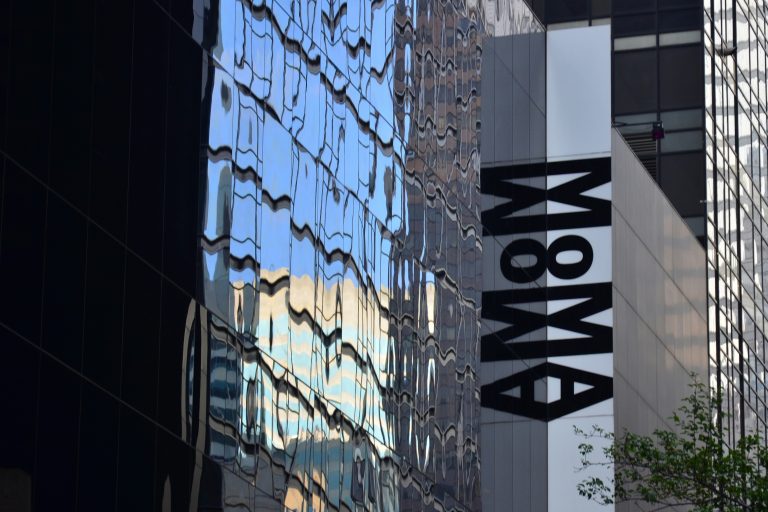
I am standing between my mother and daughter on the escalator, jammed among the crowd moving between the 4th and 5th floors of the MoMA. My mother holds her wrist in front of her face, her eyes narrowing on the small screen of her Apple Watch. The device is not working properly and she is not letting this go.
I watch the stream of people ahead of us ascend then scatter, feeling relieved to be in an airier common space of the museum. We’ve just left a Georgia O’Keeffe exhibit entitled “To see takes time….” The breadth of work had been stunning. O’Keeffe’s signature oils: sand-toned skulls and desert landscapes. Doorways, sharp and angular. Flowers, bursting open toward the canvas’ edge. Lesser known pieces: charcoal sketches so gently worked they looked like black and white photographs. A series of nude watercolors, self-portraits — pinks and reds following the folds of skin.
But the gallery had been crowded, and a large tour group overtook us in each room of the exhibit. A scrum of senior citizens moving like a glacier eating everything in its path pushed their way in front of each piece of art. They used canes and walkers as plows. They barked at the docent. They left no space for anyone else. In front of a painting of Lake George, a woman called out, “I see a narwhal!”
More than once we were subsumed by the group, spun around and shouldered to the edge of their circle. We continued like this throughout the gallery, chased by a murmuration of museumgoers. Trying to stay ahead of the tour. Trying not to succumb to frustration and let our day be spoiled.
The exhibit’s promotional posters featured a painting called Evening Star III. On its own, the piece was so small it struck me as unremarkable. I wondered why the curators chose to highlight it. Evening Star III is like no other painting of the artist’s that I have ever seen. Completely abstract. Concentric circles in deep golds, orangey-reds, and sapphire blue. The edges of the paper are unpainted, open white surfaces left exposed. It hung among a series of ten — each similar but different — repetition revealing something new in each frame. Looking at each watercolor, it’s as if we’re watching O’Keeffe see.
“Looks like a snail,” a woman from the tour group says, the heft of her body spilling over her walker-turned-stool. Her quick certainty obscures all other possibilities. I want to laugh. But I too see a snail.
I keep looking.
Maybe I see a setting sun. A calm sea. A jewel-toned bullseye. A rug unrolling. A spool with a loose thread.
Then a galaxy. Dark at first, then a swirl of stars. To see takes time.
On the escalator, my mother holds out her wrist and pecks at the screen of her watch with her index finger. It is 12:15, but the numbers on the watch face look as if under a magnifying glass. Only the bottom left corner of the first two digits are visible: the serif at the base of the 1 and the point of the 2.
I feel her tightening. I feel myself growing impatient.
“See?” she says, convinced this glitch is her own doing. We all look at the tiny screen, doing what comes so easily: letting our focus spiral in on what is not working. We replace abstraction with false certainty.
“I don’t know, Mom,” I shrug.
My mother is certain she should be able to fix this. Certain that if the watch were strapped to the supple wrist of someone in their 20s — like my daughter — it would be working. I am certain she is taking this too seriously.
But maybe, if I keep looking, I’ll see something else. A perceived barrier between herself and a changing world. A desire to stay relevant. I feel this too. We both look to my daughter for an answer.
“Grandma, I think it’s broken,” my daughter says, matter-of-factly.
My mother looks skeptical. Then relieved. Another possibility. On our slow pull upward toward the next floor, the white space of the museum widens around us.
“Relax, at least we’re not seeing narwhals in Lake George,” I tease.
My mother’s face opens to an unexpected smile, and slowly laughter overtakes her. Her tightness unfurls. The kind of loosening that pulls at a thread of joy, a surrender to the unknown. And for a moment, with her head thrown back and mouth open, darkness dissipates into twinkling light. My mother’s laughter looks like stars.
Photo by Jamison McAndie on Unsplash, licensed under C.C. 2.0

Her Substack is https://jennifergaites.substack.com
- Snails and the Night Sky - August 15, 2025
Oh man, there is so much here that I’m sure I’ll have to read it several times to figure it all out. To see takes time, the Apple Watch. Gaites skillfully weaves together art, family dynamics, and the nature of perception itself. Love her phrases: “scrum of senior citizens” and
“murmuration of museumgoers.” And the last line: My mother’s laughter looks like stars.. Stunning!
Beautiful, as always, Jen. I will summon your insight the next time my mother frets over technology.
A lovely essay. A tech mystery, three generations, three points of view, three levels of (un)ease. A stunning but crowded art show. The world almost gets in the way of what truly matters. Fortunately, in the end, a smile clears the fog.
Beautiful insightful piece Jenn! You are a true talent at spinning words into feelings. ❤️