I learned how to tag, bag and transport a body to the morgue before I ever took care of a living patient. I had been excited to meet him, Martin /Mr. Martin*. His name, age and admitting diagnosis were tucked into a neat box on an otherwise empty page, a tabula rasa of endless possibility. Would he be tall or short? Funny or sad? White haired or bald or some combination of the two? I was keen to listen to his heart and lungs, excited at the prospect of detecting an arrhythmia or wheezing or crepitus. I imagined formally presenting such findings to my nursing preceptor, her praising my keen assessment skills. We would successfully treat him and he would take up guitar or maybe curling, because what elderly person doesn’t want to hang out in the cold and shove heavy clay pots across the ice? I never got the chance. Martin /Mr. Martin likely expired at least 6 hours before I ever had the pleasure of making his acquaintance.
***
Martin /Mr. Martin was not my first encounter with a dead body. That had been eight years earlier, at my mom’s funeral. She was only 42 years of age, her death sudden, a dissected carotid artery resulting from a heretofore unknown connective tissue anomaly. After she was pronounced brain dead in the ICU, a compact woman from the organ donation organization shuffled into the family lounge seeking to procure her insides.
“Yes,” we told her, unequivocally. My mom was the kind of person who would have ripped a kidney out of her own body while still alive if it meant helping some poor suffering soul.
“Here,” she would have said, the kidney slippery and crimson, “I have another one, anyway.”
We wanted a closed casket service, preferring to remember her animated and upright, but the mortician had left her wedding band on despite our request that it be removed. My family clung like silver cobwebs to an oak paneled corner while I was escorted to the casket to retrieve the ring. Unwilling to take in the whole, I saw her in pieces: black blouse, coppery lock of hair, blush on pale cheeks. Her hand was marbled and waxy and cold, a phantom limb. I could not slide the ring over her knobby knuckle. A full-blown panic settled in my chest, erupting forth in gulping sobs.
“Help, please help!” My cry was multi-directional, pertaining to the ring, the void in my life, the indecency of a young mother embalmed. An attendant or relative hustled to my side to extract the wedding band. Freed from her finger it sat small and gold in my palm, an unbroken circle, a prematurely severed timeline.
***
“Maybe one day you will be nurses!”
My mom clutched a white box to her chest, a hopeful smile accompanying her suggestion. At eight and nine years old, my sister and I were emphatic in our denouncement of the profession. The contents of the box were a time capsule of her unrealized nursing dream: an old-fashioned nurses’ hat with a thin stripe of green velvet, a red stethoscope, a pair of orthotic looking white shoes circa 1977. I had seen similar footwear on the older Catholic nuns that haunted the pews of our church. It was the kind of shoe that carried around the bloated, stodgy legs of the chaste and repentant, a vibe that could not have been more antithetical to a nine year old. My shoes were off-brand Keds sneakers murdered in glitter puff paint, carrying feet that I vehemently declared would never see the dark recesses of a nursing shoe.
Mom had been a nursing assistant, her aspirations of becoming a nurse sidelined by my arrival. I’m not sure if she held on to the box hoping we would pick up the torch or hoping she eventually would.
“I gave patients baths and helped them cut their nails,” mom reminisced. I gagged in disgust.
“Why would anyone want to do THAT?” The hopeful sheen in her eyes shifted to sadness as she slipped the lid back into place and settled the box into a cedar chest. It saw the light of day at least once after that, as part of a Halloween costume. “Can you imagine anything more terrifying,” I asked, rearranging the nursing hat on my thick teenage skull, “than wiping an adult butt?”
***
The woman who hired me for my first degree-related job out of college did so because I shared a name with Edgar Cayce, the godfather to New Age mysticism. She was writing a book about an angel posing as a flight attendant that saves humanity.
“I got a download from the angels last night,” she would tell me before revealing that she didn’t agree with a particular edit I had suggested. “They told me that this part should stay as it was.” She went on to reveal that everyone got downloads from said angels. “When your ears ring, that’s how you know information is coming in.” She received many, many downloads, often communicated to me only over the phone and late at night in reedy, far away whispers. In the interest of my bank account, I reserved any judgements about her method.
One day, she revealed that earth was doomed unless humanity took it upon themselves to commit at least half of their lives in service to others. In her forecast, this would raise the consciousness of the planet so that humans would be included in an interstellar coalition of higher order beings. Long after I had terminated my employment with her and fled California, I would think about this statement. Hidden among the interstellar coalition, white aliens and higher consciousness was a truth about helping others that I kept tucked away in the back of my mind. Three months later, slumped in the front seat of my Nissan Altima, I summoned my soul back to my body after it had nearly been siphoned out during a job interview that would have had me writing copy for toothpastes and deodorants. I was hit then with the sudden image of mom’s box of nursing items. I thought about the stethoscope, my mom’s smile, the higher calling of helping others. I blinked, shocked by the epiphany that I’d rather wipe someone’s crap than peddle it to others.
***
Before “it just kind of happened” occurred in my own life, I didn’t understand how anything could “just kind of happen.” Life was purposeful or totally random, and that’s how things happened. My post-college years found me just kind of happening a lot; happening to drift through random freelance gigs and waitressing jobs and transcontinental moves. There was a breakup with my college boyfriend, a reorganization of what my future might look like. One day, I just kind of heard about an accelerated bachelor’s degree nursing program that could be completed in a year for current bachelor’s degree holders. I just kind of thought about it and then just kind of applied and was most definitely admitted. I held the acceptance letter, concisely worded and folded in threes, imagining the joy my mom would have felt had she been the recipient, the joy she would have felt on my behalf. Her short life was so often lived vicariously through my own. The words warped and shimmered through developing tears. I no longer had to fear that I would rot away in scratchy office attire next to a half-dead ficus. My hands did not sweat. I folded them over the letter, shut my eyes, released my breath.
***
The morning I was to meet Martin /Mr. Martin I adorned myself in anachronistic white from head to toe: starchy scrubs, squeaky running shoes, even my hair was processed from espresso to light rum, a vision in bleach. Under a black light I would have been an ultraviolet avenging angel, yielding a stethoscope in place of a holy sword. At the hospital I rode the elevator to the 10th floor and patiently waited for my preceptor, Ola, to finish receiving her morning report.
“Okay, let’s check in with our patients for the day!” She instructed, handing me my assignment. “You will have Martin… Mr. Martin? Anyway, he’s all the way down the hall to the left and was admitted yesterday from the nursing home with an exacerbation of congestive heart failure.” We approached the room and peeked in. “Good morning!” Ola addressed a pair of feet poking out from behind a vaguely geometric patterned pastel curtain. She tugged on the worn mauve fabric, pulled it aside to reveal our patient in full rigor mortis.
“Oh dear,” she mumbled sadly, rounding to the other side of the bed. Perhaps I should have been shocked, should have taken a step backward or angled for the door, but I was oddly calm. I took in the body that had belonged to Martin /Mr. Martin. He had been a tall man in life, thin in a wasted way at the time of his death, cachectic. His legs were littered with sores, which now looked like small holes dug out of his waxy gray form. It was as though he was made of a block of Swiss cheese: cold, slightly shiny, rigid yet soft. And full of holes, like an evil elf with a tiny melon baller had assaulted him in the night, removing shallow round areas of flesh. Ola turned to me.
“Well, it looks like you get to learn how to process a body! There’s a lot of paperwork involved, and we need a body bag and tags.” She retrieved the necessary items and taught me how fill out three tags: one to be placed around the big toe, one to be placed on the outside zipper of the body bag, and the other to go with the chart. We carefully arranged the vinyl bag next to Martin /Mr. Martin, rolling him one way and then another so he lay on top of the open sack. He looked to be lying atop a giant garment bag, bewildered by the fact of its emptiness and size. I tied one tag to his left big toe, depressed by its significance and intrusive banality.
Is this what we did then, with our dead? Let them get old and decompose while still alive, tie tags around their toes and contort their frozen limbs to accommodate the parameters of cheap, massive bags? Where was the ritual and care? I wanted anointing oils and purifying waters, incense and burning sage. Where were the murmured prayers, holy paints, burial shrouds? He should have been leaden down with silver or gold, sent off on a funeral pyre, entombed in marble. Instead, we placed him on a cold metal cart, covered him with a thin white sheet and made our way to the basement of the hospital where a merry security guard waved a badge to allow us into the morgue. His cheer was an odd juxtaposition to the cold place to which he granted us admittance. I assumed he was, like me, just grateful not to be the poor stiff in the bag. As we returned to the floor, I sent a small prayer into the universe for Martin /Mr. Martin. My wish was that his memorial at least be lovely, that it hold some small moment of the sacred (preferably accompanied by ululation and/or a rending of garments at the chest). I had been too young and in shock when my mom died to think about what it means to have a good death, but I knew without question this was not it.
***
Morticians and medical examiners often make offhand remarks about the ease of working with the dead. The dead cannot scream, hit, yell or cry. They hold no opinions and feel no need to convey them. They cannot throw a prosthetic leg, feces or soiled bandages in your direction, nor allow their family members to dictate wishes that are likely not their own. These are all things that would later happen to me as a nurse, eventually leading me to leave my position in the cardiovascular intensive care unit for the operating room, where my patients were alive yet sedated, held under consciousness by the modern miracle of anesthetic gases and analgesic agents.
Removed from the bedside, my only source of drama now comes from surgeons with God complexes and the occasional trauma patient; sometimes the awful combination of both at once, a bloody, self-absorbed supernova. In such moments with the living, I often think back to Martin /Mr. Martin and others that I have lost along the way. I do not envy their non-existence, but to be checked out from current reality is sometimes an enviable state. A mental health professional would probably have things to say about a wistful desire to completely detach from life, utilizing phrases like, “poor coping mechanism” and “inability to deal,” but these thoughts are infrequent, more fanciful in nature than morbid. I never want to trade places with the dead, but it might be nice to enjoy the rest of eternal slumber for a minute or two when Dr. Demigod decides to spiral into a full-blown panic about blood loss and hurl a surgical instrument across the room. Blood-soaked stainless steel in motion is never a good thing.
***
“I would have quit on the spot,” a friend responded when I told her my first ever patient was a dead one. The reasons I remain are out of necessity. I need the steady income, but I also need to bear witness. Amputations and cancer and tragic motor vehicle accidents allow me to keep the rest of my life in perspective. Operating above the surgical drape as opposed to occupying the blue space beneath it is a privilege that I have been granted, for now. I often wonder if my mom would have made it in today’s highly digitalized and bureaucratized nursing environment. She had a bubblegum vision of the profession, a notion of holding fragile, tender hands and tucking crisp white sheets around frail, helpless forms. She would have been appalled by the sheer number of callous physicians, billing codes, the utter inhumanity of modern healthcare in the United States. Would she be proud that I took up the torch and realized her dream? We can never really know what our dearly departed would think of our lives and their scattershot trajectories; their silent bones and granite memorials grant us no such knowledge. I honor them in the small acts of everyday life: a song danced to, a word written, the sound of a heartbeat through a stethoscope sounding in my ears, the thump-thump a reminder that I’m alive.
*Disclaimer: In the interest of privacy, the names of the patient and nurse in this essay have been changed so as to protect their identities.
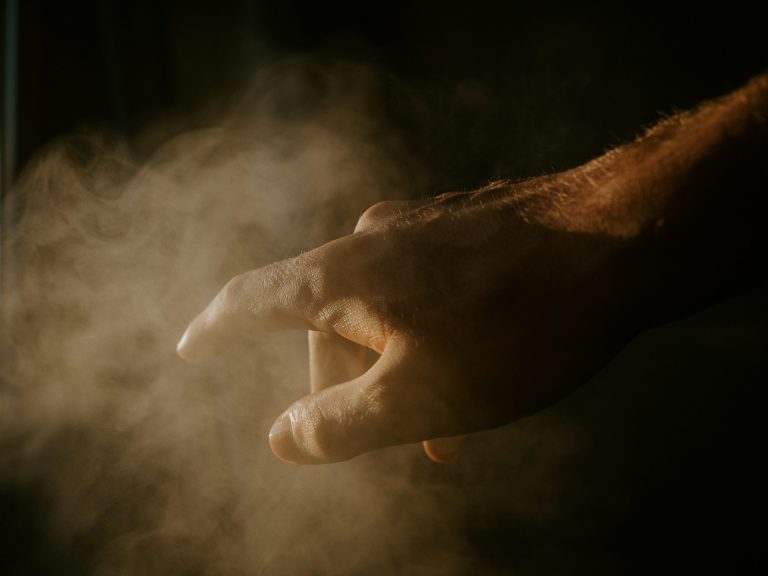
Image by Matthias Oberholzer on unsplash.com, licensed under CC 2.0.
- The Living Encounter the Dead - October 31, 2025
Here’s how to get your wish. Find a time machine, set it to -300,000 years, and hit go
I appreciated this piece