
When my brother died last year, I wrote his obituary (from the Latin obitus, pertaining to death) for the local paper.
Buddy Wicekoff, 80, died July 4, 2024, in Willow Springs, AR. Born April 3, 1944, in Willow Springs. Truck driver and CB radio enthusiast. Dallas Cowboys fan. Deacon at Sycamore Heights Christian Church Disciples of Christ. Proudly served his country as a veteran of Viet Nam. Will be greatly missed postmortem. Preceded in death by parents, Cecil and Jo Wicekoff; wife, Mellinda; and sister, Wanda. Survived by brother, Barton Wicekoff, of Willow Springs, AR.
Simple. Direct. Concise. It was my last gift to him. It does not, as so few obituaries do, capture the man.
My brother was a peach. It took most of my life to understand him. A deep, intelligent man who decided early in life that, regardless of what happened or who made it happen, he would keep his distance from the modern world and remain a small-town Arkansas boy. He spent 30 years driving long haul for J. B. Hunt. He called it “gettin’ in the saddle and haulin’ ass.” And Buddy did love that CB radio. He told me he spent half his time on the road talking to other drivers with bizarre handles like “Mad Monk” and “Evil Eyeball.” Buddy’s handle was “Mr. Goodbar.” Perfect. One of his friends from the road left a card at the funeral that, under different circumstances, I might have laughed at. It said, “You’ve parked your truck now; your engine has stopped. You drive the streets of heaven on the trucker’s last ride. 10-7, Good Buddy, from the Innocent Bystander.” I had to look up that “10-7.” It’s CB radio code for “out of service, not available to respond.” Poignant (from Latin pungere, to prick). The note pricked me.
The local newspaper felt the need to “edit” what I sent them. And, as is common with small-town papers, mistakes were made. Thinking to correct me, they put only one L in Buddy’s wife’s name, which was Mellinda, not Melinda. And they failed to include a U. S. flag under his photo, even though it says in the obit that Buddy was a veteran. Irritating, but Buddy would not have minded.
My brother loved bright colors. He had his truck painted bright yellow and kept it shining clean. He would dress in the most outrageous colors at unexpected times, like when he gave the roast at a friend’s wedding. He wore purple pants, a yellow shirt, and a green sports coat. I called him the court jester, and he laughed and jumped into the stork pose. It was such a Buddy thing to do. I didn’t include his love for loud colors in my obit. It didn’t strike the right tone.
I considered omitting that Buddy was a deacon in Caldwell Heights Christian Church Disciples of Christ. We both hated church as kids and quit going as soon as we got out of the house. But after he married Mellinda, he started up with church again. I don’t think he actually drank the cool aid. Buddy was too smart for that. He was a thinker, and he was curious about the world around him. I’m pretty sure that church could not answer the questions that mattered most to him — “good god” and “existence-of-evil” kind of thing. I’m thinking he went back to church just to please Mellinda and ended up a deacon because he was so good with people and wouldn’t have said no when they asked him. He had a gift for making folks around him feel noticed and valued. But even as a deacon, he never gave up his Bud Light and Cuban cigars. Every Saturday we watched some football and indulged in both. I wish now I had asked him straight up on one of those afternoons why he went back to church and became a deacon, but I felt as if I would be prying.
Buddy was a Vietnam veteran in the U.S. Navy, a signalman on a destroyer. He never talked about it much, and I didn’t want to be nosy, but a couple of years ago, while we were sitting on the couch watching the Chiefs kick the Cowboys’ butts, out of the blue he said, “In Nam, we never came under direct fire, and we were always happy to oblige when the Marines asked us to blow up the coast.” He grinned and winked at me. Then his face got this serious, kind of perplexed look, and he said, “The only time I got close to the action was when we were assigned a month of river duty in the Mekong Delta. It happened three times in ‘69.” He looked down at his beer can and was quiet for a minute. Then he turned to me and said, “Whenever we had to tie up on the river overnight, we knew Charlie might be in the bush watching us with bad things on his mind. We had two sentries walking the deck all night, keeping a sharp eye out for swimmers. The sentries would drop percussion grenades over the side to keep those sneaky bastards from sticking a limpet mine on the hull.” He looked at the TV like he couldn’t remember why we were watching. “I couldn’t sleep. Percussion grenades going off. I’d lie in that bunk room down below the waterline and listen for a bump on the hull.” He shook his head. “I was a mess by the time we pulled out.”
I didn’t put any of that in the obituary.
Wanda, our little sister, if she were still alive, would have worn the most outrageously bright colors she could find to the funeral. I never knew anyone who loved life as much as she did while she was growing up. She was the epitome of carpe diem. She went off to college at Penn, an Ivy League school, on a scholarship while Buddy was in Viet Nam. The first month of the spring semester, she wrote home saying she was marching with the war protesters, carrying a sign that said, “Stop Killing Babies.” I called her and asked what the hell she was doing. She said she was protesting the war for Buddy and all the other boys who had been dragged into an unjustifiable war. I said, “What the hell do you mean by unjustifiable war? They’re communists, Wanda.”
She said, “Open your mind, you dumb hillbilly,” and she hung up.
The rest of that spring semester we didn’t hear a word from her. She came dragging home the last week of May looking thin and haggard, spouting Marxism, sneaking out to the garage to smoke pot. Mama and Daddy were real uncomfortable with the pot smoking. I didn’t mind so much. Hell, I joined her one time and tried it myself. I had to lean on the car to prop myself up, and I said, “I feel like I’m falling into a real deep hole.”
She smiled and took the joint from me, then said, “Abyssus abyssum invocate.”
I was confused. I said, “What did you say?”
She laughed a little and said, “It’s Latin. It means deep calls unto deep. Pot is pretty deep stuff.”
She tried to hand the joint back to me, but I waved her off. “Are you studying Latin?”
“Yes,” she said. “It’s my favorite class. Don’t even know why I took it.”
I think I was a little embarrassed and thought she was getting uppity. I told her she didn’t look healthy, she wasn’t eating enough to fill up a house sparrow, and we could all do without any more lessons from Karl Marx.
She got tears in her eyes and looked away from me, then let out a big sigh and said,
“Absolvo.”
“What does that mean?” I was getting a little angry.
She knocked the glowing head of the joint onto the floor and stepped on it. She twisted the open end of the joint and dropped it into her blouse pocket. “It means fuck you, Barton.”
Buddy came home in late June. We were so happy to have him back that we almost hugged him to death the first day. But it only took a couple of days to see that he was struggling. He said he’d been depressed for several months, and that the Navy doctor had given him a little bottle of pills before he was discharged and told him by the time he finished them he’d be fine. “I hope so,” he said.
Buddy’s second week home, predictably I guess, he got into a roaring row with Wanda. They started off just huffing and growling, but it escalated into screaming. When Daddy and I tried to step in, Wanda started screaming at both of us, and Buddy told us to stay out of it. Mama stayed in the kitchen. Wanda finally screamed through her tears, “You don’t understand anything. We were just trying to help you and the other boys. We were trying to stop the war.”
Buddy laughed at her. He said, “You’re the one that doesn’t understand a damn thing. You’re nothing but a little communist bitch, and I can’t stand to be around you anymore. In fact, I never want to see you again.”
The room went dead quiet, and Wanda stood there looking like she had been slapped. Buddy had never spoken to her like that. I’d never heard him talk that way to anyone. Wanda looked down at the floor for a long time. I could barely hear her say, “Adsumus.”
Buddy rolled his eyes. “What the hell is that supposed to mean?” He breathed hard into the quiet.
She took a minute to answer, and when she looked up, there were tears in her eyes. She said, “Here we are.” Then she turned and walked out of the room and did not come out of her bedroom for supper. Mama sat there eating with tears rolling down her cheeks. Nobody said anything. It felt like eating in a morgue.
The next morning Wanda walked into the kitchen and dropped her overstuffed backpack on the floor. “I need a ride to the airport after breakfast,” she said. She walked over to the stove and poured herself a cup of coffee.
We stood there, dumb, and watched her sit down and put some eggs and bacon on her plate.
Mama said, “Wanda,” her voice quivery.
Wanda didn’t look up. “I don’t trust your driving, Mama,” she said.
After a few seconds, I said, “I’ll take you.”
She glanced at me, her smile weak, then went back to eating.
Buddy leaned on a chair across the table from Wanda and said, “Where you going?” His voice registered a level of threat that surprised me.
“None of your business,” she said, biting into a piece of bacon. She took a drink of coffee, and when she looked up at Buddy, her eyes made my heart ache. All that hurt maybe from what Buddy said the night before or maybe from the sound of his voice there in the kitchen. “If you really want to know,” she said and took another drink of coffee, “I’m going back to Philadelphia, as far away from here as I can get.”
Mama let out a quiet little groan, and Daddy sat down in his chair at the head of the table.
Buddy gave Wanda a hard look and walked out of the kitchen without eating.
On the drive to the airport, Wanda and I filled the time with idle chat. I asked her what she would major in. She said she might major in political science and maybe get a graduate degree and teach. Her grades were good. She was real smart. We avoided the topic of her going back to Penn weeks before school started. Avoided the fight with Buddy and the heartbreak for Mama and Daddy. I wouldn’t have known what to say about either topic.
Over the next few weeks, we didn’t hear from her. I called her a couple of times, but her roommate always said she wasn’t there and didn’t know when she would be back. I decided not to keep calling. Left the ball in her court as they say.
At the end of the fall semester, she transferred to UCLA. She wrote a short letter saying the west coast suited her much better than Philadelphia. She loved the weather and the sunshine. She was happy. In April we got a call from the Director of Student Services, who, in a soft, practiced voice told us that Wanda was dead. Offered his condolences. She had been killed during an anti-war protest that had turned into a riot. They thought it had probably been a police baton that delivered the blow to her head that killed her, but in the confusion no one could be certain. And that was that. I flew out to California and made arrangements to have her body returned home. There was a nice turnout for her funeral. She still had friends in Willow Springs, and Mama and Daddy’s church did a nice job.
Buddy’s depression, which had cooled considerably over the previous eighteen months, overwhelmed him again. He spent most of his free time shut up in his room reading about the war — magazines, books, newspapers, anything he could find. After six months, he came out of his cave and started going to counseling. He slowly returned to his old self, though he never quite got rid of the sadness in his eyes. It might have been that sadness that made him so good with people.
A year later he married Mellinda. He bought his eighteen-wheeler and began to live his life again. On the road five days a week. Mellinda went with him most of the time. And I, for some crazy reason, started taking Latin classes at the community college. Two years, three evenings a week. I loved it. Studying a dead language, something that had nothing to do with anything else in my life. Go figure. Wanda would have gotten a kick out of it. At every class I thought of her.
About six months before Buddy died, we were watching the Michigan-Ohio State football game when he started talking about Wanda, something he rarely did. For two hours, long beyond the end of the game, he talked and I listened. He had read all those books about the Vietnam War after it ended, and he felt he came to understand what Wanda had done. “Wanda was right,” he said. “It was a nasty little war. And Wanda had such a good heart.”
“Sui generis,” I said.
He shook his head. “What does that mean?”
“One of a kind,” I said. “Latin,”
He seemed to be pulling his grief up from the depths into which he had sent it all those years ago. The lines of his face formed around it, and I felt I understood, as I never had before, what he might have suffered. “Amor et melle et felle,” I said. Love both sweet and bitter. Or both honey and venom.
Buddy frowned. “More Latin?” When I nodded, he said, “Whatever.”
Yesterday I was flipping through one of my old Latin texts, something I enjoy doing now and then, and came across the word pecco (sin). I had very little response to the word “sin” until I saw that pecco comes from the Indo-European root pik (to be angry). Anger and sin. Anger as the root of sin. Anger plagued our house for a brief season in 1971, and like venom it spawned corruption and death.
Buddy retired the year Mellinda was diagnosed with breast cancer. He sold his truck, and they bought a camper van, also bright yellow, and often took it to the lake for a few days. They mostly camped in the middle of the week because Buddy didn’t like for camping to interfere with our Saturday afternoons. For the two years between her diagnosis and her death, they lived a serene and happy life. And two years after Mellinda’s death, Buddy died of a heart attack in his sleep. He had always said it was the best way to go, just not wake up in the morning. The reward for a life well lived.
In 1956, when I was ten, Buddy twelve, and Wanda eight, we lived on a dead-end street at the edge of town. We were about a half mile from the river and had a well-beaten path from our back yard through a farmers’ fields. We built a stile to get over the barbed wire fence at the back of our yard. In the summer we went to the river almost every day, as did most of the other kids from the neighborhood. Sometimes now, on a good night, I dream of those summer days, like a black and white movie with a dream glow infusing everything. But sitting here in the overstuffed chair on the front porch, I remember the dark green algae on the rocks, the endless blue sky, the orange breast of a robin on a limb of the sycamore tree that leaned out over the river. The tree’s white trunk and furry green leaves. The clear water, the big limb that had fallen from the tree lying on the gravel bottom. Daddy had hung a rope out over the river from the sycamore with a stick tied onto the lower end so we could sit or stand when we swung from the bank, dropping from the rope into the cool water, screaming.
We rarely saw snakes, scared off by the noise and splashing, but one summer Dillon, a skinny eight-year-old boy who lived up the street from us, startled a cottonmouth in the warm shallows on the far side of the river. We had an almost mythical fear of cottonmouths because their poison was powerful. The snake bit Dillon on the ankle. As I held the rope swing while Buddy climbed on, I looked up and saw Dillon jerk his foot out of the water. As Buddy yelled and dropped from the swing, Dillon stared at me, his eyes wide. In the few seconds Buddy was under water, Dillon yelled, “It bit me.”
“What bit you?” I yelled back. “A crawdad?”
As Buddy resurfaced, whooping, Dillon yelled something I didn’t understand.
“What was it?” I yelled again.
Buddy looked over his shoulder at Dillon and said, “What was what?”
“Something bit him,” I said. “Throw me the rope.”
Dillon started walking toward us, out into the clear water. He was beginning to cry and said, “A cottonmouth.”
Buddy yelled “Shit” and swam hard toward Dillon. He staggered through the waist-deep water up to Dillon and grabbed his arm, saying, “Come on. We need to hustle.” He dragged Dillon back toward deep water. He scissor-kicked and swam with one arm, pulling Dillon through the water. When they reached the near edge of the river, Buddy yelled, “Help me get him up the bank, Bart.”
We pulled him up the slippery mud bank shivering. Buddy turned his back to him and said,
“Hop on, quick.”
Dillon climbed onto Buddy’s back, and Buddy started running up the path toward the house. He ran the half mile to our back yard with Dillon clinging to him. I ran along behind him, and Wanda, who had missed the exchange at the river, ran behind me yelling, “What happened to Dillon, Bart? What happened?”
“Snake bite,” I yelled over my shoulder. “Cottonmouth.”
Wanda stopped in the dirt path. I didn’t notice until I glanced back over my shoulder and saw her standing there, looking like she had seen a car wreck. I yelled, “I’ll come back,” and kept running after Buddy. When he got to the stile, he carried Dillon over, hardly missing a beat. I yelled, “Jesus, Buddy!” By the time I got over the stile, Buddy was going through the back door with Dillon, calling for Mama.
Buddy didn’t put Dillon down until he sloughed him off into the back seat of the car, then jumped into the passenger seat up front, breathing hard. As Mama was opening the driver’s door, she turned to me and said, “Where’s Wanda?”
“She stopped on the path,” I said. “I’ll go get her.”
Mama got in the car, started it, then rolled down the window. “Bring her to the house and wait here. I’ll call you from the hospital.” And with that, she backed out in a rush, hardly bothering to look behind her, and gunned it up the street. It was only then, standing in the driveway watching Mama run the stop sign at the end of the block, it hit me. Dillon might die. If he didn’t, he’d have Buddy to thank for saving his life. Buddy and Mama.
I ran around the side of the house, scrambled over the stile, and headed toward where Wanda had stopped. She sat on the dirt path crying. She and Dillon were buddies. When I reached her, I bent forward, put my hands on my knees, gasping for breath. She didn’t acknowledge my arrival. Her hands covered her eyes and nose. When I got my breath, I said, “It’s okay, Wanda. Buddy and Mama took him to the hospital. They’ll take care of him.”
Without taking her hands from her eyes she said, “Will he die?” She seemed to be holding her breath, waiting for my answer.
“No,” I said. “They’ll give him a shot or something.” I sat down beside her. “He’ll be back at the river before you know it.”
Her hands dropped to her lap, and she whispered, “He might die.”
I put my arm around her shoulders. “They won’t let him die, sweetie.”
We waited at the house, as Mama had told me, watching the Mickey Mouse Club on TV. Wanda loved watching that show. The cast was our age, a bunch of kids. All the boys were in love with Annette Funicello, the prettiest girl on the show. Watching TV distracted Wanda that day until Mama called from the hospital. Dillon was going to be okay. The doctor said it was a good thing they got him to the hospital as quickly as they did. Big snake, eight-year-old boy, bad combination.
Buddy never said anything more about carrying Dillon from the river to the house at a dead run. It was as if he never gave it another thought. But I did. I felt the cold breath of mortality on the back of my neck. The swimming hole had always been a place set apart, where we forgot about parents and teachers and the pain of the world. Nobody had ever been bitten. But after that day I was wary. I imagined Death slithering across the rocks on the far side of the river, slipping into the clear water, weaving his way toward me as I tried to scramble up the slick mud bank. Half in the water and half out, I knew, with a certainty that can come only to a child, that the grass ledge was beyond my reach and that I could struggle with all my might, but I would never be able to climb out of the river. And Death could take his sweet time moving through the water, while I clawed at the bank and fell back, helpless.
But Buddy’s contagious confidence gradually pushed those fears to the back of my mind. Buddy and Wanda and I were close as kids. He was the big brother. While he was alive, I wasn’t much afraid of anything. But he is gone. Mr. Goodbar is gone. It’s just me, and I’m lost. Buddy asked me once what my CB handle would be. I told him I had no idea. But now I think I do. I would go with the Latin Nemo (no one).
I wrote my own obituary. It was easy. I haven’t done much.
I think often of that sympathy card left at Buddy’s funeral by his truck driving friend, the Innocent Bystander. The name has settled around me over the years. I too have always been an innocent bystander. And I wonder if all this time I have chosen simply to stand by, not to live. My obituary is signed and sealed and in a business envelope, held by a local lawyer, who will send it to the local paper when I die.
Barton Wicekoff, (age), died on (month, day, year). Worked at Willow Springs Furniture Factory for 45 years. A Kansas City Chiefs fan. A member of no church and no political party. Preceded in death by parents, Cecil and Jo Wicekoff; the best brother any man has ever known, Buddy Wicekoff; and Wanda, the sweetest sister on this earth. Survived by no one. Omnis bene est qui finit. All is well that ends.
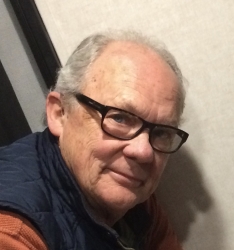
Image by Judah Wester on unsplash.com, licensed under CC 2.0.
I enjoyed reading this article. You are a talented writer Gary.