


When a book opens with a question, it’s often an invitation to journey along with the author. “How do we keep doing this — making art?” asks Stacey D’Erasmo in The Long Run: a Creative Inquiry, named a “Best Book of 2024” by The New Yorker. As she examines her own creative process alongside the numerous artists, musicians, and writers she interviews, D’Erasmo prompts her readers to examine their own life and work.
Reading The Long Run, a genre-defying book that’s part memoir, part interviews, and part reflection, I felt as if I were looking at my own long run through the lens D’Erasmo provides. Her writing, as transparent and moving as a clear mountain stream, impelled me to examine my own contradictory long run, as a musician, a writer, a daughter, a sister, and a wife.
My writing journey began smack in the middle of my career as a concert pianist. Writing was something that fit into short slots of time between hours of practicing, rehearsing, and teaching, with a notebook perched on top of my Steinway grand. It wasn’t until I eventually retired from professional music-making that writing became my full-time occupation.
Career-switching among artists is apparently common. D’Erasmo writes that the artist Ruth Asawa had “planned to stay on the more practical teaching path” (94) before pursuing her art. Yet Asawa “knew she wanted to be an artist by the time she was ten, drawing and crafting in every spare moment—” (93). I, too, had begun drawing quite early, even before I began playing the piano. During college, after attempting a double major in music and art, I realized there weren’t enough hours in the day to do both well, so I chose music. While I had always dreamt of a creative life, lack of money left me pursuing education as a career. It took a professor’s intervention to send me in another direction. I found company in what D’Erasmo writes about the composer and conductor, Tania León, “her grandmother’s imagination … gave León the impression … that she could be someone different, that the world was bigger than what she saw every day” (91). For me, it was my college piano professor who led me to graduate school at New England Conservatory of Music where I was thrust into the exhilarating, but financially haphazard world of performing.
Two years before that, another college professor had told me, after reading my final paper for his class, “You clearly have a gift — you should be a writer, not a musician.” I ignored that advice for many reasons. The main one was that my father, who began molesting me when I was three, had struck a bargain when I was six: “If you promise never to tell, I will get that piano you’ve been begging me to buy.” He honored his promise. But my part of the bargain was always with me as I played it — I could make music, but I could never tell what had happened to me. Music was safe. Words were not.
When I reflect on my years of performing, and the inner dissonance that grew over the childhood bargain I’d made with my father, another quote from D’Erasmo’s interview with León speaks to me: “I still feel like that child, (that she’s) inside of me, looking out of my eyes. Sometimes I might be involved in big things, or conducting an orchestra, and suddenly I think, ‘Oh my God, what am I doing?’” (90). The contradiction between scared little girl and professional adult musician lived inside me throughout my years as a concert pianist, beginning with my debut as a soloist in Boston’s Symphony Hall in my twenties performing Shostakovich’s 2nd Piano Concerto. My father and mother were seated near the stage, and the three to five-year-old inside of me was cowering while simultaneously fighting to break her silence with words. Was music my hiding place? In one way it was a refuge and a means of expression, in another way it was a replacement for what I couldn’t yet express in words.
While I struggled with that contradiction in my musical life, family tragedy threatened to split me in two. Broken by trauma in our family, my two older brothers took their own lives within eight years of each other during their twenties. I began keeping a notebook on the piano where I would write my grief during practice breaks. This very act resonated with what D’Erasmo quotes from interviewing the writer Samuel Delaney, “For years I carried around a little notebook in which to write ideas on the front of which I wrote the famous Kafka quote, ‘The book must be the axe for the frozen sea within us’” (51). My brothers died with their pain frozen inside them. My writing was the axe to break through the ice that threatened to end me.
Since I used my writing over the years to parse out the meaning of my brothers’ suicides, it resonated with the way D’Erasmo describes the poetic forms she’d utilized in her first novel, Tea.
The refrain was the suicide of the main character’s mother… The suicide was that ever-lingering sound… Every time she returns to the event, she interprets it according to who she is and how she thinks at that time. The event doesn’t change, but its meanings continue to spiral with every repetition… (51).
My thinking and writing about the “ever-lingering sound” of my brother’s suicides has evolved over the years. Due to one brother’s death by gunshot, I avoid fireworks on July 4th. Since my eldest brother hanged himself, I cover my eyes when there’s an image of a hanging on screen, or even an empty dangling noose.
The notebook I kept on my piano grew into Memory Slips, my memoir published in 1997 when I was 41. I’d been seeing a psychiatrist who’d lost much of his family in the Holocaust. He said to me, “Tell so you can live, and live so you can tell.” I didn’t want to die with toxic family secrets frozen inside, yet to tell was to break my promise to my father. While reading The Long Run, I stumbled on a sentence D’Erasmo quoted from Delany which perfectly encapsulates the idea of telling so you can live: “He became, in other words, the author of his own life, to save his life” (58). After pouring my grief into notebooks for over a decade, I decided it was time to tell so that I could live, and to become the author of my own life.
In writing Memory Slips I broke my childhood promise by writing about my what my father did to me as a toddler. The title comes from every classical musician’s nightmare — a “memory slip” is when you momentarily forget the music you’ve memorized while onstage. During my mid-thirties I was performing Beethoven’s Sonata Op. 109 when a late-comer arrived. I heard echoes of my father’s long-ago footsteps approaching my bedroom, and I had a dreaded memory slip. Suddenly, I had no idea where I was in the music or in time.
Once again, D’Erasmo provides a mirror in her depiction of the dancer, Valda Setterfield whose career was disrupted by a train accident: afterward, Setterfield “would often find herself somewhere with no memory of how she’d gotten there” (20). That was how my onstage memory slip had felt: I didn’t just forget what notes to play and improvise my way back. I was lost in time with no sense of how I’d “gotten there.”
I paid a big price for telling so I could live. Memory Slips precipitated a long estrangement from my family of origin. Living well beyond my brothers, which was the goal, came at a cost. While reading The Long Run, I was struck by a contradictory sentence that helped me to reframe some of the difficulties: “We are neither as bad as we fear nor as good as we like to think we are; that one person survives certain circumstances and another doesn’t owes as much to contingency as conscious choice” (143). While this quote is a study in contradiction, it unburdened me of some of my survivor’s guilt.
The year that I was writing my memoir, I met the love of my life. The only problem was that he was twelve years younger. I had been raised to believe that the man must be in charge, and therefore must be older. My husband not only loved me, he was a haven through the publicity and family upheaval when Memory Slips was published. I found a reflection of that when I read D’Erasmo’s description of Valda Setterfield’s sixty-seven-year marriage to the choreographer and dancer, David Gordon in their performance of Chair: “The chair is always there; the marriage, too … a lifelong duet … In Chair, Gordon doesn’t lift Setterfield; instead, he helps her remember how to lift herself” (21). This lovely metaphor for an empowering union got me thinking about my own thirty-year marriage. While I’ve experienced more than my share of depression, my husband has often helped me lift myself out of it.
My marriage has long fulfilled my own desires and sexuality, largely because my twelve-years-younger husband has always helped me to feel safe. He has also unlocked previously unexplored parts of myself — desires I never knew I had. While the biggest contradiction in marrying him was to circumvent what I was raised to believe, and what many friends had warned against, following my desire was the best decision I could have made.
When I read early on in D’Erasmo’s book, “My partner takes off his shoes and socks and stretches out on the grass” (38), I was confused, as I’d only known her to partner with women, and wondered what was happening. I found my answer forty-six pages later: “In my mid-forties, desire for men came back into my life … I felt as much desire for women as I ever had, but now another room had opened within me and it wasn’t going away” (84).
Another room. Was that a contradiction or simply an expansion? And at a time when LBGTQ rights are threatened daily and marriage equality is under attack, what does it mean for a queer woman of D’Erasmo’s generation to make room for heterosexual love? Both coming out as queer as a young woman and publishing about being with a man later in life must have taken tremendous courage.
Raised in an evangelical Christian family, I was wrongly taught from an early age that homosexuality was condemned by the Bible in 1 Corinthians 6:9 where the word first appears. I didn’t learn until much later that the word never appeared in English translations of the Bible until 1946, when translators of the Revised Standard Version changed it from the Greek word, arsenokoitai, referring to abusive predatory behavior — an older man taking sexual advantage of a child. I knew that sin very well, from experience with my own father. I also learned that forty years later, one of the RSV translators publicly apologized for this mistaken translation and the pain it caused. How much easier to make this real sin — that of sexually preying on someone smaller — into the “sin” of same sex love? Yet how much holier to embrace those you love, no matter who they are. Or as D’Erasmo puts it, to allow love and desire to open another room.
That said, I did wonder how D’Erasmo found peace with this “new room.” She describes how difficult it was to integrate her desires for men with being queer:
This felt… like a betrayal. I was fearful of the breach my shift in identity might cause. The identity on which I had built my life, and that had saved my life, was no longer what I thought it was. If this later version of myself were a photograph, it would be a woman I didn’t recognize… (84).
Further on, she writes, “It’s a strange price to pay, but that is where my desire path has taken me” (85).
At its core, The Long Run is about living, loving, and working with one’s contradictions intact. I began dog-earring pages where D’Erasmo illuminates contradictions. She writes about the singer/songwriter Steve Earle, and how, over the years, his vibe “shifted from burning arrow to melancholy buffalo to tender elder” (142). On the last page, when I encountered her final sentence, “I clacked the stones together in my pocket” (157), I wrote in the margin: In the end, this is a writer who’s making music — a contradiction and reversal of my own creative process.
I began looking at all my own contradictions — a student who began college studying visual art along with music, then shifted to music full-time; a musician who eventually began writing; a daughter who broke an untenable promise; a sister who outlived the odds of losing two of her siblings to suicide by writing about it; a retired performer and teacher choosing to write full time; a woman bucking tradition to marry a younger man because that’s where love and desire led her.
As someone whose entire life is filled with antithesis, I was delighted to find another sentence about contradiction from D’Erasmo: “The difference … may come down to moral luck, but part of that moral luck may itself come down to who can stand to hold all the contradictory pieces of their life at the same time” (145). There it was in black and white: D’Erasmo’s answer to living with and working with antithesis — to hold all our contradictory pieces at once.
When D’Erasmo muses on John Keats’ description of negative capability, she writes, “Our desires is conflicting, always. That continued friction generates considerable heat for making art, if you can bear it” (148-149). The singular “is” for the plural “desires” is not a grammatical error, but a quote taken from the artist Amy Sillman discussing her video installation, After Metamorphoses. It’s as if the word, “desires,” though bountiful, is a singular noun when taken altogether. An answer to my own questions about integrating music with writing, survival with death, and desire for a much younger man with the traditions which I was raised on, this also holds the key to where the heat for making art emerges — in holding onto all those contradictions.
Stacey D’Erasmo’s book opens doors to living, loving, and creating with one’s contradictions intact. It’s a genre-defying book filled with the wisdom of the authors, musicians, and artists D’Erasmo interviews. Reading The Long Run puts you in conversation with all these creative minds. My hope is that it will also allow you to crack open another dialogue: one with yourself.
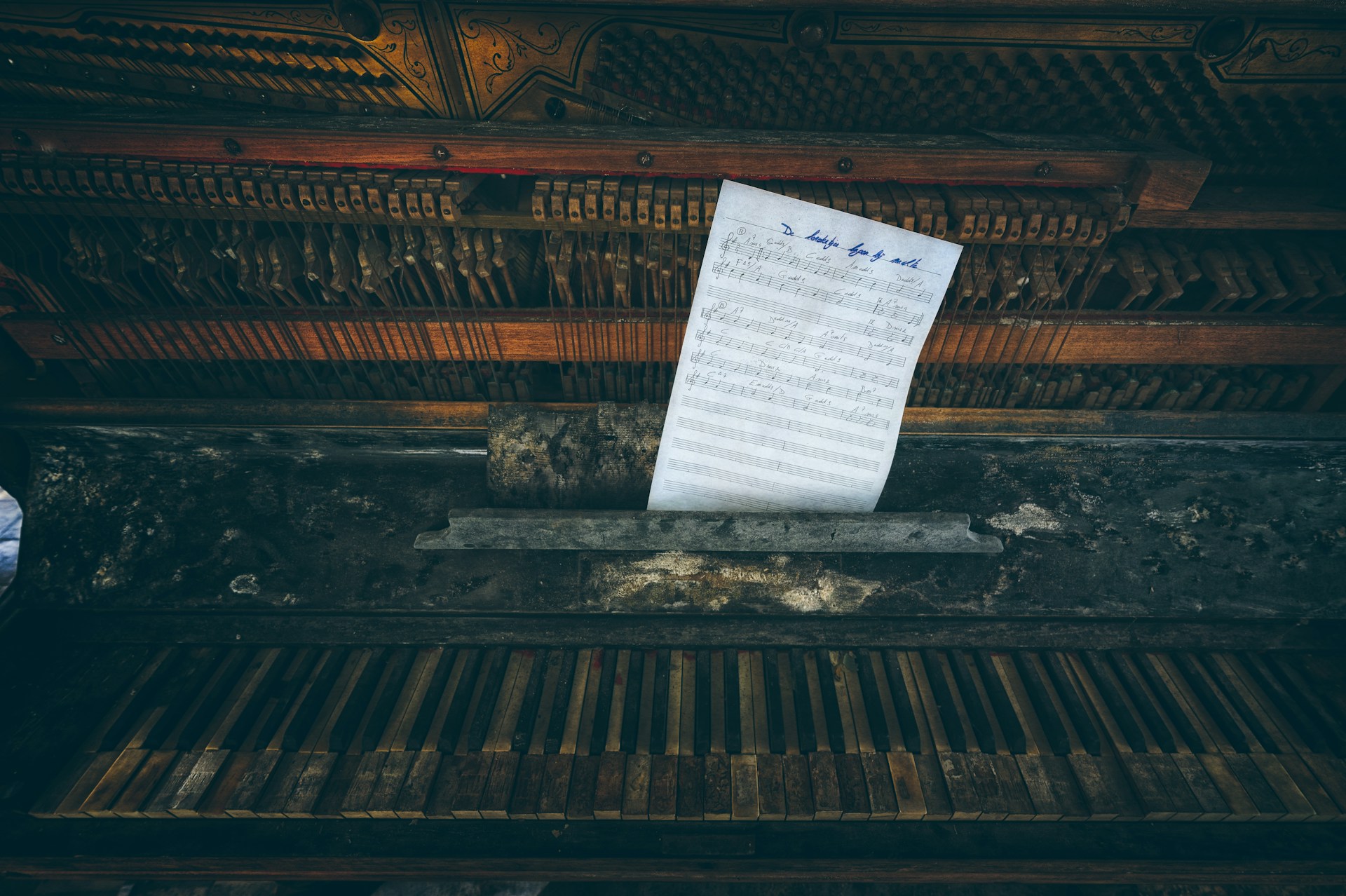
Image by Peter Herrmann on unsplash.com, licensed under CC 2.0.
- Looking Through a Lens: The Long Run - November 7, 2025
- Why American Classical Music Has Stayed White - June 19, 2022