


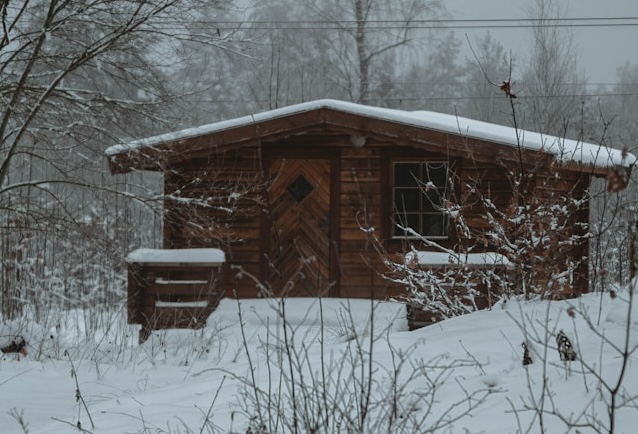
Then snow fell. It was early afternoon, and by late afternoon it was still falling. When he came out on the train platform the sky was gray, the skeletal trees bare and black, like a pencil sketch. Under the snow, the tracks were faint lines that ran into the distance where everything blurred into a fog.
Utility poles rose along the snow-covered tracks, tall and wetly black, and the ground was white, so white in that steel gray landscape the blinking red of a stop light caught the eye. Out of the stillness sounded the horn of the arriving train.
A dim light, like dawn, appeared around the curve. The train pulled in, huffing, its headlight glaring, and in its light you could see snowflakes falling, and there was snow like cotton garlands on its cars and more wind-swept snow falling like flour on the edge of the platform, and it was cold.
The doors slid open with a light thud. From the platform he watched, his hands in his pockets, as passengers disembarked. He recognized them by the bright red scarf his granddaughter wore. Coming down the steps behind her was his son, lanky, clad in a black overcoat with a gray tasseled scarf fluttering. He cut a frail figure in the bleak landscape. At forty-one, though pale and delicate, he still looked youthful. His long hair draped around his neck, over the scarf, his black-rimmed glasses a tad too big on his bony face, bearing, as always, the graceful androgyne look.
“Grandpa!” The little girl ran into his arms.
“Lina!” He smiled affectionately as he bent to hug his granddaughter.
Vy stood holding a piece of blue carry-on luggage, with a duffel bag slung over his shoulder. “Dad,” he said, “can we go inside? I need to use the bathroom.”
“Sure, son.” He thought of the snow-covered roads. Some of them might turn icy after sunset. “But let’s hurry.” He grabbed the carry-on luggage from him.
“That’s her luggage,” said his son. “For the whole week.”
He noticed the stoop in his son’s posture, the duffel bag heavy for his frail frame. “Give me that,” he said and reached for the shoulder strap.
“I’ll need it when I’m in the bathroom,” said his son.
Inside the station it was warm. He sat on a long wooden bench facing the wall-mounted cast iron radiator. The gray tiles were wet with footprints. He brushed snowflakes off his granddaughter’s hair, which had grown longer, past her shoulder, since he last saw her in the fall.
“Would you like a cup of hot chocolate?” he asked as she lifted her face at him.
“Yes, Grandpa,” she said, smiling. “I’d love that very much.”
He kissed her between the eyes, which had a faint upsweep, symmetrical with the delicate tilt of her cheekbones. He loved her acorn-brown eyes. He rose and went to the vending machine outside the closed ticket office. On its glass door hung the train bulletin board. The train that had just arrived was the last of the day. While the machine whirred, filling the cup, he looked out the window: a desolate whiteness except for the red-blinking railroad signals in the distance.
He walked back to the bench with the hot paper cup in his hand. Next to Lina sat a White woman. Her purple parka had streaking snow daubs on the front. When she caught Lina’s eyes, she wiped her front with her mittens and smiled.
“Hi, sweetie,” she said.
“Are you cold?” Lina asked and gave her the cup. “This will keep you warm.”
“Oh, aren’t you sweet?” The woman smiled again. There were wrinkles under her pale blue eyes. She cupped her hands around Lina’s. “But thanks. I’m fine, honey.” She caught him looking at her and said, “You have such a lovely daughter.”
“She’s my granddaughter,” he said, then motioned with a twitch of his head toward the restroom. “My son’s in there.”
“My mistake,” the woman said softly. “She has your eyes . . .”
“I know,” he said, nodding. “My daughter-in-law is white.”
“And you’re Korean? Or Chinese?”
“Vietnamese.”
The woman massaged her hands. “Not so pleasant a day for traveling, is it? Are you from here?”
“Yes.” He received the cup from Lina, paused, and sipped. “And you?”
“I grew up here in Frederick County. My husband is from Massachusetts. So this kind of weather in the winter doesn’t bother him.” She put her mittens in her parka’s pockets. “Your son is here to visit you?”
“No.” He put the cup of chocolate back in Lina’s hands. “He’s set to fly out to Chicago tomorrow on business.” He glanced down at Lina. “So I’ll look after her while he’s gone. They’re from Eastern Shore.”
“How nice. Whereabouts on Eastern Shore?”
“Queen Anne’s County.”
“What about her mother?”
The woman’s voice was tender, so he ignored her curiosity. “She passed away. Four years now.”
“I’m so sorry.” The woman gently lifted Lina’s face by her chin. “How old are you, love?”
“I’m seven,” said Lina with a twinkle in her eyes. “No, I’ll be seven in late October. Isn’t it the most colorful month?”
“It is,” said the woman, chuckling. “You’re beautiful and whip-smart.”
That drew a quiet laugh from him. “She takes after her father.”
“What line of business is he in?” asked the woman.
“He teaches Physics at the U.S. Naval Academy in Annapolis and heads a research program in partnership with NASA’s Goddard Space Flight Center in Greenbelt.”
“I see,” said the woman, nodding solemnly. “Busy with seminars and conferences. That sort.”
“Yes. He regularly attends symposiums. Most of them are out-of-state.” He engaged her eyes. “What does your husband do?”
“He owns a John Deere franchise here in Frederick.” She tilted her head to one side and smacked her lips. “I want him to retire. He’s getting up in age now. Our son is in line to take over. Actually he’s supposed to be here to pick me up. The roads must be bad.”
“Yes. I must check on my son. It’s getting late. Can I leave her here with you?”
“By all means. I can watch her all day long.”
When he stepped inside the restroom, his son was injecting a syringe into his left arm. He was leaning against the counter, head bent, his long hair falling over his face. On the countertop lay a black case, unzipped, filled with insulin pens, a glucose meter, alcohol wipes. To see his son like this always made him feel hollow.
“Are you alright, son?” he asked.
“Yes, Dad. I’m done.” His son’s voice was clear, soothing as he put the pen back in the case and zipped it. “I’m sorry to hold you up.”
“You’re not. Let me have your bag.” He picked up the duffel bag. It was heavy. It was his son’s travel companion over the years. He remembered seeing it eight years before when Mya Faye drove up to his log cabin on a snowy day with that duffel bag in her car’s back seat. She had driven an hour and a half from Eastern Shore to ask him to read the draft of her manuscript, a biography of her father’s life, who was his longtime colleague. And freezing rain had kept her at his place overnight.
***
It was dark when they reached the cabin. He had left the lights on, and the wood stove insert was still burning, and it was warm inside. The one-bedroom cabin had a bathroom and a kitchenette.
He went to the shed attached to the back of the house to fetch firewood. In the quiet, the snow no longer falling, he could hear tiny tinkling sounds from the creek. There might be a thin sheet of ice now on its surface, he thought, but the creek still flowed under the surface.
He could smell a warm odor of food when he stepped inside the cabin. Vy had set the table with Lina helping. The round oak table had four Windsor arrowback chairs. They were all as old as the cabin, with only one spindle having been replaced in all that time. The wobbliest chair, the one that had its four legs refitted with carpenter’s glue was his favorite.
The pot of white rice steamed as he scooped it onto Lina’s plate. She loved white rice and fish, so he had made salmon before he left for the train station. She could eat a whole bowl of white rice on its own, sometimes with just a teaspoon of soy sauce added. He had also made a pot of vegetable soup and homemade wheat bread for Vy, for his son’s low-glucose diet. In the warmth of the cabin, the wood stove burning low, over the quiet hum of the radiator he could hear the howl of a coyote.
“Is that a coyote, Grandpa?” asked Lina, cocking her head to one side.
“Yes,” he said. “You remember what he sounds like?”
“I know it must be a coyote.” She raised her glass of water to her lips. “It might not be the same one I heard the last time, though.”
He chewed slowly, hearing the coyote break his howl and start yipping. “It could be him. I saw his footprints the last time it snowed. Two weeks ago.”
“I want to see his footprints. Maybe he’d come by tonight.” She picked up a small cooked carrot. “Where does he sleep at night, Grandpa?”
“In the snow. Or maybe under the bushes.”
“You showed me deer tracks near the creek. Maybe with this snow we’ll see more animal footprints tomorrow morning.”
“Yes, dear. We will.”
It was past eleven o’clock when his son and granddaughter finally slept in the only bedroom on the cedar log bed he had built himself. The cabin was quiet and dim, save the warm glow of the cast-iron wood stove. He stood in the bedroom doorway, watching them in their sleep. Long strands of hair covered Vy’s face. Next to him, Lina was curled up like a puppy. His heart throbbed with affection. A fragile moment of rare happiness.
He checked the fireplace. The heat warmed his face as he fed more wood into the firebox. He saved the kindling, for the fire was still going strong with the bricks he had laid in the bottom of the wood stove, which helped maintain the heat inside the firebox.
He half closed the vents and went and sat down on the couch bed, also made of cedar logs, next to the kitchenette. By the side of the futon, were two framed pictures. He gazed at one then the other. His wife in her early years. She had that comely frailness he saw in Vy. Then Mya and Vy, each sitting on a bicycle, helmet in hands. He’d gone to Queen Anne’s County to visit them when Vy was teaching Physics at the Naval Academy. It was shortly before they were married.
Whenever Lina was here she would stop by the couch and look at the pictures. “Mommy was beautiful,” she would say. And he would nod in agreement. Mya’s sky-blue eyes made him think of Nolan’s; but her elegant looks came from her mother, Nolan’s second wife. With her brown hair pulled back in braids from her forehead, Mya’s perfectly oval face was fresh and lovely when she smiled.
***
It had been ten years.
There were icicles along the eaves of his cabin on that February Sunday morning. Snowdrifts coated the pine boughs, and the icicle-bearded branches bowed. The coffee mug was still warm in his hands when he saw her coming up the snow-covered trail in her red Volvo. It was a twelve year-old car Nolan had given her while she was a junior in college. Nolan was her father and also the former bureau chief at Time Magazine when they worked together in Saigon, and he was Nolan’s chief political analyst.
He remembered Nolan’s Vietnamese mistress and his suite on the third floor of the Continental Hotel. “I remember his so-called Happy Hour during our work week,” he said to her. “I would go up to his suite and sample all kinds of hors d’oeuvres and meet all sorts of personages and newsmen. You could hear his sonorous voice. You could hear him praise the American press, one of his soft spots, I must say. He knew all the top dogs in the CIA bureau in Saigon. The American generals were his buddies. They held him in high regard. Under his leadership as Saigon bureau chief, Time had an edge over Newsweek in covering all major action arenas.”
“I’m very proud of him,” she said, her eyes gleaming.
She wanted to write a biography about her father. He had agreed to the interview and, at her request, given her all his former Time contacts in Vietnam.
The first time he had met Mya, however, was at Nolan’s funeral. He came up to the casket and found himself standing behind a girl in a black suit. Her head bowed, she stood in silence. She had a pristine face, pure as the pattern of butterfly wings. When he left the casket, he greeted Nolan’s wife whom he knew back in Saigon during the war. The girl was standing by her side. The girl, twentyish, was looking at him with a curious expression, those sky-blue eyes, so similar to Nolan’s, trained on him.
“Dear,” Nolan’s wife said to the girl, “this is Cao Xuan Mat. Mr. Matt was your father’s colleague in Vietnam.” She turned back to him. “This is Mya, our daughter.”
He himself never corrected his American colleagues and foreign journalistic acquaintances about their pronunciation of his name. Matt for Matthews was fine with him.
“Hello,” the girl said, inclining her head.
He nodded at the girl. “I believed you were born in the Grall Hospital in Saigon.”
Mya took a sharp breath, her hand covering her mouth. Her mother shook her head. “She just got her first job.”
“Twenty-two years,” he said. “What do you do?”
“I work for a city newspaper as an editorial page editor.”
“April sixth, nineteen seventy?”
“You remember my birthdate?”
He smiled. “I had the blessing of holding you in my arms when you were a few months old. Ask your mother.”
“Troi oi!” exclaimed Mya in Vietnamese.
Mya’s slight accent made him chuckle. At least she said it better than Nolan. “Your father taught you Vietnamese?”
“No, my boyfriend.”
“Your boyfriend?” He tipped back his head. “Is he Viet?”
“Yes, he is.”
“Interesting. Is he here?”
Mya shrugged. “I wish. He doesn’t have a car, and today is the day he presents his Ph.D. thesis.”
“I see. What college?”
“University of Maryland. Where I graduated.”
“Well, well.” He raised his face ceilingward. “Isn’t that a coincidence? I believe my son is defending his thesis today too. I must call him.” He shook his head at his slip of memory. But he was confident that Vy would defend his dissertation well.
“Your son?” asked Mya. “What do you mean?”
“He too has his dissertation defense today.”
“In what field?” Mya asked.
“Physics.”
“What?” She gasped. “What’s his name?”
“Vy. Cao Xuân Vy.”
“Oh God! My boyfriend.”
My son. He took a sharp breath, shocked as he was, and much as she was.
***
He lay down. The fire crackled and the coyote howled again. The sound trailed into a desolate quiet. A long and lonely quietude. That long-ago evening she had sat there on the fireplace rug while a cold rain fell on the town. It was very cold that night, and in the night he had heard the ice cracking in the creek, and then the dry barking of a fox somewhere in the woods, perhaps ranging in search of a female or maybe hunting an opossum or a woodchuck.
It took him a while to fall back to sleep.
***
His son and his granddaughter were sleeping soundly in his bedroom. He went to the wood stove. The cabin was warm enough, so he adjusted the damper to let the fire burn low. After he lay down in bed, he could not fall back to sleep. All the years had added up. Then one Sunday afternoon in late February, Mya drove up to the cabin. She brought with her the first draft of her manuscript. He saw her pulling up and getting out in her high boots. It had snowed the night before, and there was a thin cover of snow on the ground. As he came out, she pointed into the woods. Two red foxes, beautifully coated in bright orange, circled beneath a tall hemlock, turned and twisted and leaped at each other playfully. Their orange furs flashed against the quiet white of the snow.
“I’d never seen them before,” she exclaimed with her breath smoking.
“Me neither,” he said. Then, “The red fox you saw the last time, the one with mange, remember?”
“Yes?”
“I saw him with another fox. Identical looking, mangy too. It took me by surprise. I didn’t know he had a mate. But both were bare almost to their flesh. These two over there must be their cubs.”
“They look more adult, don’t you think?”
He nodded. He felt good that at least the old foxes had offspring. He hoped that the young foxes would not suffer mange. A cold wind rushed through the woods and the rain-sodden air felt like air before a storm. She checked the gray sky and opened the car door. Next to a duffel bag was a canvas shoulder bag.
“I have a gift for you,” she said, picking up the canvas bag.
“You don’t say.”
“Here,” she said. “Surprised?”
Inside was a thick stack of sheets bound with large rubber bands. A glimpse at the top page did indeed surprise him. A Double Life. The title of her book about her estranged father. Then beneath it, her name: Mya Nolan. She had kept her maiden name after marriage.
“So,” he said, holding the bag by the strap, “you finally wrote it.”
“And you’ll be my third eye,” she said. “Be tough on me.”
“I can read it now. But it’ll take a few days.”
“I should’ve been here earlier. My printer was too slow. So, I went to a Staples and they printed it for me.”
Inside it was warm. A smell of overnight old fire and wood hung. He offered to make her coffee, but she said she was okay. “I can bake cookies while you take a peep at the first chapter. I won’t leave until you read it.”
Her azure-blue eyes smiled. She went to the kitchen cabinet. “Do you have flour?”
“Yes. Everything should be there.”
“What kind do you like?”
“Oatmeal cookies.”
“I like them too. So, you have rolled oats and raisins?”
“Yes.”
After a while, he left her to herself and became engrossed in what he was reading. He looked up when she came by him, her hand on his shoulder. “I’m going out for a stroll. Be back in fifteen minutes.”
Later, he paused at a freshly-baked, buttery-rich warm aroma coming from the oven. She came back in, dusting wet snowflakes off her hair.
“I love the smell,” she exclaimed.
He could see snow coming down. But there was no white flakes on her car. It was wet.
“You might want to get going,” he said. “This wet snow might turn to freezing rain soon.”
“Let me get this out first,” she said as she pulled the tray out of the oven. The air smelled moist and buttery-warm. She gave him a cookie from the middle of the batch.
He took a bite and closed his eyes. Heaven. He always loved this raisiny-chewy, crisp-around-the-edges taste. He smacked his lips. “You should take half of the batch home. Vy would love them too.”
“I will.” She leaned her head toward him. “Tell me your first impression of what you’ve read.”
“I like it. Well, I love it. You’re a real writer. For a while I forgot that you’re a journalist.”
“Just like you. An analyst and a journalist. Aren’t we the same?”
At her charming smile, he could not help but smile too.
After she left, he made a pot of coffee and went back to reading. As he read, he would pause to write notes on the margin in pencil. She was succinct and accurate, particularly with the geographical names and proper names in Vietnamese. The first chapter was long. By the time he was through, he had finished two cups of coffee. He realized he had not even smoked one cigarette. Her writing had held his attention. It was getting very gray outside, and the ground was wet with a sheen. On the windows of his station wagon, parked to the side of the cabin, there was a film of ice.
He was thinking of making dinner. He could re-toast the leftover cut of tilapia which he had floured and baked the night before, pour some of his homemade sauce on it, and eat it with white rice. It was dusky and wet when he stepped out. He pulled the cord of the exterior light fixture, and as he stood there in its warm glow, he saw her making her way up the trail in the rain. She was on foot and drenched. He hurried out. She nearly slipped on the sleek ground. She extended her arm, and he grabbed it and helped her into the cabin.
“Good God,” he said, brushing rain-soaked hair off her brow. It felt icy. “What happened to you?”
“Roads are impassable,” she said, sniffling. “One was blocked. I had to turn back. I could only make it so far and pulled off the road. I walked maybe a mile from there.”
“Go change,” he said, feeling her shaking. “Or you’ll catch cold. I’ll get you something to change into.”
When she came back out, she was wearing his white cotton pants and a flannel checked shirt which looked loose on her. She came to sit by him in front of the wood stove as he fed firewood into the box, a woodsy warming smell breathing in his face and making her face glow. He handed her a glass of Inniskillin Riesling icewine, and they clanked glasses. The wine was crisp.
She bit her lips after a few sips.
“Lovely icewine,” she said. “So fitting for tonight.”
“You know how it’s made?” he asked.
“I know how to drink it,” she said, giggling.
“They pick the grapes at dawn after the grapes have been frozen overnight on the vine.”
“Like tonight? Seriously?”
“Yes. In sub-zero temperature. The misery of picking them with frostbite is somebody’s pleasure in the end. Yours and mine included.”
“I love this bouquet of apricot and honey and orange peel note. Don’t you love its marvelous long finish?”
“I do.”
“Can I have another glass, please?”
***
The book had sat on his bedroom bookshelf for five years. His name was on the dedication page. The first time he read her book he was moved. It was a complex book, yet made simple and honest by her clever way of presenting the chronology and her psychological understanding of the man she portrayed and the byzantine politics that had roiled the country he called Veetnam. The morning he read the first review by The Washington Post while having breakfast in the food court, he had such an odd feeling. He was reading a critique of her book about a man he could never detach himself from. But such a man had been his colleague and friend for two-thirds of his life. There were other reviews in the weeks to come. He felt she was deservedly praised.
When he came out of the bedroom that morning she was making coffee, looking out the window. He stood, watching her still wearing his clothes. Out back the wintry landscape looked like a natural quilt patched with fabric in black and drab gray and brown. Trees stood frigid, their black trunks ribbed with ice, their ice-laden boughs bearded with glistening crystals. The holly branches were packed white with hard snow so white its fruit peeked through in a breathtaking red. On the eave, snow-sculpted trickles of water had made crystalline spikes, and they sparkled in the cold sun. She turned and said, “I just made fresh coffee. Would you like a cup?” Her voice was jovial, her face fresh and radiant.
***
One night, he dreamed he was somewhere in a desolate land. Frost winds chilled his bones. In the air was the silty smell of the creek water, decayed leaves and sere grass and vegetation. A blue empty sky. In him swelled a quiet longing. Something fell undulating from the sky and his fingertips caressed something like waves slipping through fingers. Substance that had no marrow. He was gazing at the long strands of silk. They glowed like sunlit fibers, coming not from without but within, shimmering silk, gossamer-thin, flowing as light as mist. The strands were blue, azure blue. Blue as hope.
***
The book that had sat on his shelf for five years now was the same book he had brought with him to the hospital on her final day. She had been sleeping a lot, and was in and out of consciousness. The cursed pancreatic cancer had arrived that morning when he placed the book on her chest. Vy and his two-year-old granddaughter had been there all night. There were two chairs in the room for them. He held her hands in his, the book too, on her chest. And she, in one precious moment, opened her eyes and touched his hand. In that fleeting second, he sensed that she was him in essence, one who ferried between the two shores and yet belonged to neither. The blue was still in her once beautiful eyes.
Image by Lucas Larsson on unsplash.com, licensed under CC 2.0.
- The Things We Lost - July 27, 2025
- Ask the Sea - June 6, 2023