


March is coming, I need to get ready. I have to find that pin.
It’s time to rummage through my jewelry box. Find the stash of Mărțișor pins; ignore, but not yet toss the one that’s completely worn out. The one with a bit of teal? Nope. Not very traditional. The pin that’s still wrapped in its original plastic sleeve, the same way I bought it in 2004 during the last and only time I visited Moldova? I still haven’t had the heart to shed its plastic. Nope, too nice.
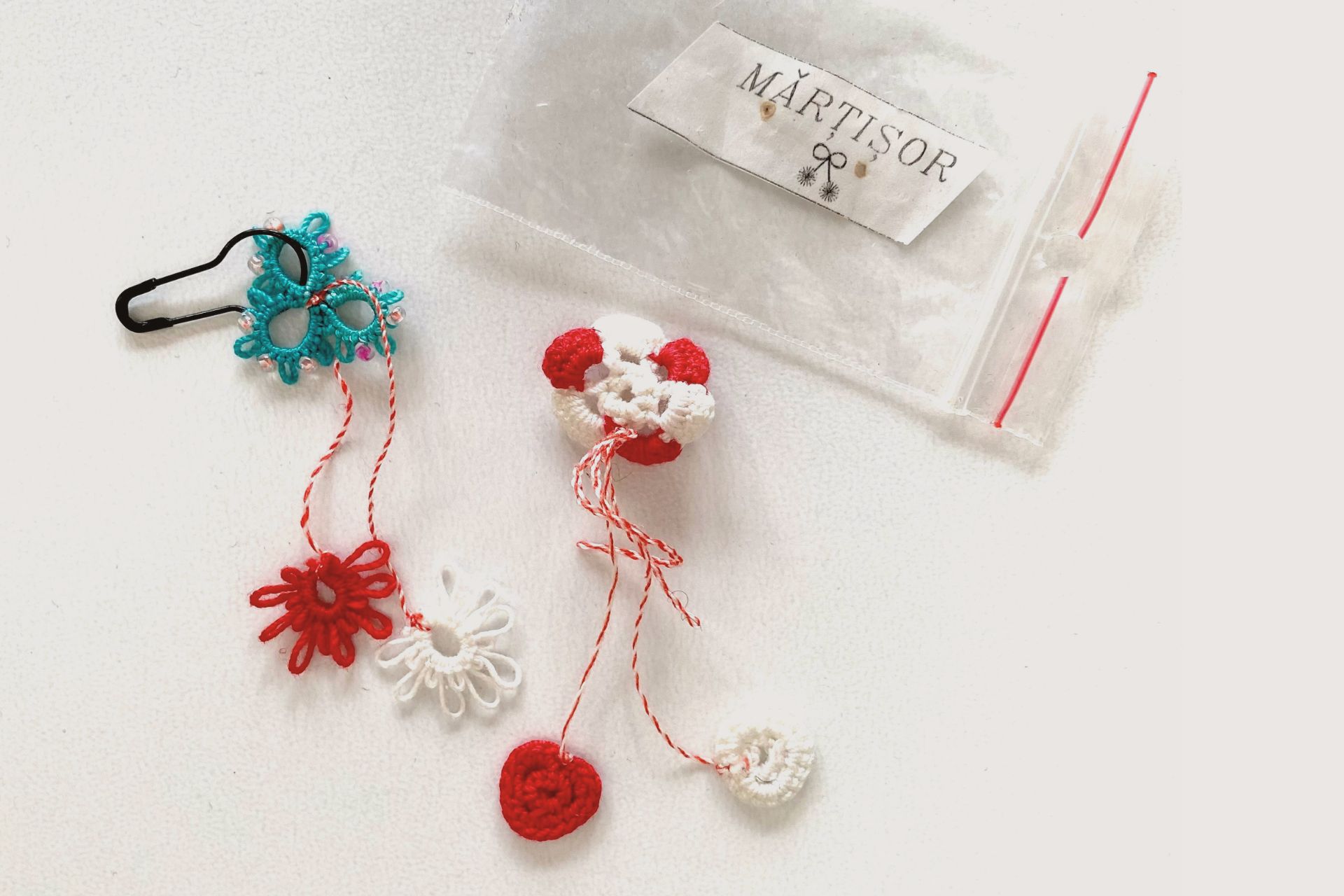
The Mărțișor pin I choose is handmade with a red and white crocheted base and intertwined string with two spheres, showcasing the same colors. Even though I’ve worn it for many years it still looks crisp, intact.
Starting every March 1st, I wear one religiously. Every morning I don the pin on the outside of my jacket or sweater so the world can take note. Before bed, I take off the pin and lay it on my dresser. I want to be sure I will see it first thing in the morning. I don’t want to forget. On the last day of March, I wistfully tuck the slightly disheveled pin back into my jewelry box.
Sometimes, outside or at work, people notice and I get to talk about it. Often, people don’t ask, and that’s okay too.
When I taught high school, I always took the opportunity to celebrate the pin and Mărțișor at our staff meetings and point it out to my students. Very few people have heard of Moldova, much less Mărțișor, and I loved putting my mother country and its tradition on people’s mental maps. But sharing where I’m from is about more than storytelling.
Mărțișor (pronounced mar-ti-shor) pins mark the holiday of the same name, meaning “Little March” in Romanian. In addition to Romania and Moldova, it is celebrated in Bulgaria, Macedonia and Albania. There is a related tradition in Greece. The holiday and its pin date back to the time of the Dacians, around 4th century BC, who lived in Transylvania before the Roman conquest. The Dacian New Year, celebrated on March 1st, marked the end of winter. After wearing the talismans, the Dacians hung them on trees for a year of good luck and prosperity. The Romanians still do the same.
Mărțișor connects me to the part of the globe I am from, my whole world for the first ten years of my life. I remember my city Kishinev, since renamed Chisinau, where I reconnected with my early life and bought a handful of Mărțișors. The city of honeyed linden trees, hopscotch and my favorite homemade swing, creaking on our tiny veranda, next to the pungent onions.
Every year my school held a Mărțișor competition. During the last week of February, the halls buzzed with the excitement of thawing icicles, warmer days, and craft making. My grandmother would sit me down at the kitchen table, spools of red and white thread and cardboard pieces laid out in front of us, the small black and white television idling in the corner. She showed me how to make one type of Mărțișor by cutting cardboard into circles, then wrapping first one thread then another around the circles to create fluffy balls of color. Finally, how to intertwine two balls. My cutouts and the resulting Mărțișor were scruffy, but I didn’t mind. I don’t remember winning the competition, only my curiosity and elation at seeing a variety of creative red and white pins on display in our third grade classroom.
Mărțișor makes visible a part of my identity usually invisible. I am a refugee from Moldova, but I don’t speak Moldovan, except for a few words. Ethnically, I’m not Moldovan either, though my grandparents and their grandparents are from the region. Back when my family left Moldova to seek asylum in the United States, Moldova was part of the Soviet Union. Russian was the official language when my parents were born, as well as during my birth and upbringing. I would have started learning Moldovan in 5th grade, but we left after my 4th grade graduation. At home, we spoke Russian.
Ethnically Jewish, my family tree is Bessarabian, and I grew up in a city made infamous by the 1903 Jewish pogrom where nearly 50 Jews lost their lives, an untold number of Jewish women were raped, and 1,500 Jewish homes were damaged. Years later, before I was born, we lost family members in the Holocaust. In 1989, as Anti-Semitic protests and the threat of pogroms increased, my parents fled the USSR. I didn’t grow up Jewish; it was safer that way. I knew nothing of my heritage; we left before I experienced othering and discrimination the way my parents had. To add insult to injury, the USSR took away our citizenship during our immigration. We were considered defectors, betrayers of the Soviet way.
Since leaving Moldova my parents have never worn their Mărțișor. I’d never asked them why, until I began this essay. I assumed their underlying pain. I wasn’t wrong.
“We’re not in Moldova now,” my dad responded. “We’re not Moldovan.”
My dad means ethnically, not nationally. All he knew for the first 37 years of his life was his native Moldova. The same country that threatened violence against him and his family. The same country that betrayed him.
I find it strange, having a hyphenated identity — being a third culture kid; having a different nationality from both my birth country and my adopted country. Incredibly powerful, to be sure. Fascinating, too. But complex. My narrative, my story, has multiple vantage points and resists simplification. Taking out some of the hyphens means disconnecting from who I am.
There are around 272 million international migrants worldwide, and that number continues to grow rapidly. As Pico Iyer described in his TED talk “Where is home?” taken together, we represent the fifth largest nation on earth.
It takes time and effort to make yourself visible to others. Emotional labor, too. As a refugee, and a child, I didn’t have agency in leaving. As a result, when I meet people who have heard nothing of Moldova, I experience conflicting feelings and needs, equal parts pain and hope.
Occasionally, a person smiles and nods when I tell them where I’m from. I still remember a middle-aged man who nodded his head enthusiastically at the name of my country, telling me about his Peace Corps experience there. I tingled at being seen.
Most of the time, the experience is the opposite. Once, I spent close to three hours on the phone educating my date.
“Where is Moldova?” he wondered. With the help of Google, we pulled up a map.
“How is it there?” He sounded genuinely curious. I described what I knew, then admitted to not speaking Moldovan.
“Why?” he asked.
“I’m Jewish,” I said, met with a befuddled silence.
After untangling race from religion from the culture of Judaism, and illuminating the bearing of all these on my immigrant identity, I realized I couldn’t feel any more disconnected from the person on the other line, though he genuinely wanted to understand me. I felt exoticized and othered. Why couldn’t he see me? We never spoke again.
While I tell people I’m from Moldova when asked about my accent, my pronunciation is a mixture of influences, none of which are related to Moldova. Russian is my mother tongue; I’m fluent in Spanish as well. My speech is a hybrid, too.
At one point, I tried to learn Moldovan from my grandparents who were born before the Soviet Union annexed their region, at a time when it was still called Bessarabia and included Romania. Every time I visited my grandparents, I would practice Moldovan vocabulary and ask for a few new words. Moldovan is a Latin based language, and the cadence sounds like a mix of Spanish and Italian. I love its melody. But my language practice didn’t grow. For my grandparents to understand me, I had to keep deferring to Russian. It was our common language.
Before she passed away, my grandmother switched back to Romanian. Romanian, of which Moldovan is a dialect, had been her first tongue. Part of me is glad I wasn’t there in her last moments — it would have hurt too much not to understand her last words.
Despite being illiterate in Moldovan, I am of Moldova. My geographic home lives viscerally in my memory and body. Our early environments shape us, and the streets of Kishinev are as precious to me now as when I was a child. The elementary school with its large front yard, and the house where both my mother and I grew up. Cafe Prikindel, where my grandmother bought me ice cream I relished while peering into large aquariums full of colorful fish. The pastel houses, the tree lined boulevards, the park where I collected glossy chestnuts — nooks and crannies filled with memories of family and friends, the places where my world took root.
As a teacher in San Francisco, I loved watching my immigrant and refugee students zoom in on Google maps to show me the shapes of their towns, their streets, their homes. Seeing San José La Máquina in Guatemala and Duchengzhen in Guangdong Province in China, and hearing the stories connected to each place, helped me see my students more clearly; to taste a bit of the worlds that shaped who they are.
For me, donning and doffing the Mărțișor brings me in contact with my heritage in a tangible way. It’s a daily reminder I savor each day in March. I love that the origin stories of the pin itself are all tied to contrasts: white and red, winter and spring, old man and young maiden. While the Moldovan and Romanian folk tales are different, both try to make peace with winter’s reluctant departure: volatile March weather that can plunge us into cold days, while slowly making way for a warmer season. This resonates for someone with multiple identities. Amidst the dance of code switching and identity balancing, the grief of invisible loss is mixed with gratitude for new ways of being and incredible opportunities.
Somehow in March, the red and white strings of the Mărțișor intertwined on my outwear, my external and inner selves are in congruence. The pin makes three dimensional and complex what daily life often requires I flatten and simplify.
While the red and white pin marks my difference, it also signals a sense of belonging to a larger whole. To the world. To all parts of myself.
Photo courtesy of Vlada Teper.
- Finding Myself Every March - April 1, 2026