The week I read Emily May’s essay collection Some Girls, I visit the Wayne Thiebaud exhibit “Art Comes From Art” at the Legion of Honor in San Francisco. I once read that people often feel disappointed when they see original art they know from a reproduction. I worked at a publishing company and each morning when I walked up the stairs I’d see a Thiebaud poster as I headed to my desk. Before I stood in front of the original (and frequently replicated) “Cakes and Pies” at the museum, the pastel pastry fever dream had elicited a bit of joy. It was whimsical and ascetically pleasing. But in person, up close, it wows. It’s the opposite of a letdown and it feels riddled with meaning. The oil painting looks three-dimensional, diorama-like. The meringue on a lower-left pie appears almost an inch off the canvas, so tempting, sinful even. I couldn’t be the only one imagining what it would be like to reach out and take a gluttonous lick. I quickly realize the dull white of the posters have nothing on the opalescent whites in his original works, heady and thick and lustfully glistening. The white is both everything and nothing.
While the work of Thiebaud typically brings to mind bright gumball machines and pastel cakes, his work goes beyond culinary confections, including stunning female portraits and cityscapes, but it’s the pie slices and parfaits that leave me astounded. Up close they are anything but trite, exploring themes including American consumerism and excess. And this makes me think of May’s nine succinct, yet deeply meaningful essays that delve deeper, exploring feminism, art, and belonging. On the surface, Some Girls is pleasing. It’s a good read. It even has an inviting cover in an almost-Thiebaud palette, lilac and peachy pink with illustrations of strawberries (all done by May and published by Galileo Press, who also published my book Occupations). But there’s also a tiger coming and going; there are lips in a contemplative twist and a woman on a phone who echoes a modern-day goddess. Like the work of Thiebaud, it may look inviting at first, but it’s not about being adorable.
In “Confessions of a Slutty Virgin,” May’s first-person account shows herself as a teenage girl navigating the treacherous halls of school with chatter of a “hot list,” in which she isn’t named, doesn’t want to be named, yet has conflicting feelings about not being named. This reminds me of being a teenager, in the era before cellphones, standing in our kitchen talking on the beige wall phone, trying to stretch the cord as far as possible so my feminist mother wouldn’t overhear me as I tried to get intel about the list boys in our school had made, rating each girl — the beginning of my confusing struggle with the male gaze.
May continues to parallel my own adolescent thinking in the title essay. “As a teenager, it seemed to me that being desirable to boys was an annoying, arduous process of playing a trick — present them with a fantastic image and then work constantly to maintain it: arrange yourself into something they’d like.” She writes how young girls are set up to “cannibalize each other,” reminding me of when I asked my mother if I was prettier than one of my friends. She told me it didn’t matter and that she wouldn’t answer such a question. But am I? I pressed. I was trying to rank within my own ranks.
In “Under the Paving Stones, the Beach!” May, a recent college grad, heads west with her handsewn clothes and stacks of Gary Snyder books to work on a marijuana farm in Humbolt County, with her best friend, Kelly. She deems them “a latter-day Jack Kerouac and Neal Cassidy.” She tells her parents that the farm grows berries and tomatoes. With her free time she drives with Kelly over the Bay Bridge to Berkeley, blasting Bob Dylan. The duo stroll Telegraph Ave for books and Thai food and I am reminded of my own early trips to the same places, with the same agenda, having moved to San Francisco from New York in my early twenties. “Kelly and I wanted to travel the world, never get stuck, never sacrifice our ideals. Having to compromise what we believed in to stay alive loomed like a cliff.” Like May, I wanted to be a writer and I didn’t know how to get there. I left a job at a major publisher to move to the Bay Area and couldn’t find work. I applied at coffee houses and bookstores and after being rejected for seasonal help at J. Crew in the mall, landed as an editorial assistant at The San Francisco Chronicle, where one of my jobs was to answer the phones in the art department. I was told that even though he no longer worked there there would be calls for Robert Graysmith, a former staff cartoonist who penned the well-known book about the Zodiac killings. Odd voices who didn’t identify themselves asking to speak with the true-crime author occasionally broke up my 11am-7pm union shifts (which I was thankful for so I could go out late and sleep late). I lived in a tiny studio hovering above the Tenderloin where my neighbor, a now well-published poet, and I used the squeezeboxes we bought in Chinatown to call one another through our open kitchen windows.
I wandered around the city with my notebooks, retracing the San Francico Beats, marveling at City Lights bookstore in North Beach and the nearby 1010 Montgomery Street where it was said Allen Ginsberg wrote “Howl.” Some of my friends were getting married, a few having children. I was dating poets because I wanted to be a poet. I didn’t go to my high school reunion on the East Coast and a friend reported back that there was a bulletin board with notes of those who didn’t attend and my read: “Lives in San Francisco.” Living in San Francisco was my only certainty and even that wasn’t so certain as I would abandon jobs and apartments to go back and forth to New York, always returning to California because there was still something so wild and open that drew me West.
In her twenties, after the marijuana farm, May stayed on the West Coast and landed in a utopian Portland, Oregon, albeit a place where one barista job garnered over 200 applications. She writes about making ends meet with nanny jobs and some creative accounting with roommates and a staggering water bill. But even through the struggle, there’s a preemptive nostalgia of leaving a place while she’s still there. “One day, I would be very far from here, but I would remember it all, especially biking over the bridge, the sun low in the purple sky as I headed home to Northeast, a small corner of a city that I loved, in a country that rarely made sense to me. ‘We will do every thing we set out to,’ I wrote during that time, a command to myself. ‘We have to.’”
May’s essays use that command — a determination to take the reader with her across the country and abroad (including Thailand, where she travels to teach with Ginsberg’s poems in her suitcase), through sexual experiences, the doldrums of work, and a deeply meaningful friendship with Kelly. She shows what it’s like to yearn for home and feel a sense of belonging all while refusing to conform to a life that doesn’t fit. She traverses the familiar territory of an artist puzzle-piecing together daily survival (a snack-size bag of popcorn as dinner, reused coffee grounds in morning) while creating, and caring not only about her art but also the work of others. Some Girls is relatable and entertaining. Upon closer reading, May wows with intelligence and precision of language. Her well-crafted memoir is anything but ordinary, even if the themes are universal — a hard chord to strike. And, like Thiebaud (whose show includes the works of artists he collected), May also “makes art out of art” — refencing writers such as Snyder, Henry James, and Sandra Cisneros.
Fast forward to 2024 and May is living in Austin, working in fintech, and is the voice of reason to an intern in “Are you there Richard Linklater? It’s me, Emily.” She wavers between feeling she has somehow failed by earning a living (“enough to buy new shoes!”) and knowing she’s doing the best she can. And she’s writing sentences of her own even after being “chained to a laptop” all day. She skillfully turns this chapter of her life into art. I return a few times to a passage that reminds me of the twenty-something May in Portland: “On a rainy November day I look out at the sparse trees with their dangling green and yellow leaves streaking the brown trunks and imagine it as an oil painting in front of me, and it seems like an answer to something. How could I forget that observing the beauty of the world is the whole point!”
On my first read of Some Girls, my own-coming-of-age memories and experiences — moving around in my twenties; wanting to be a writer and not knowing how — come flooding back, some of which make me cringe, but mostly I am grateful. When I reread the collection, I’m startled by a new parallel. Like many people in mid-life, my plans took an unexpected detour and I had to begin again. I am now wildly, and sometimes frighteningly, free (shortly after setting out on my own, I stood at a crosswalk in Cole Valley as a car blasted Dylan’s “Like a Rolling Stone”). I don’t know what’s around the next corner, or if there even is a corner. A yearning for home and a sense of belonging while not conforming is still my path. I remind myself of all the uncertainty I traversed when I was younger, and that maybe not knowing is a certainty in itself.
In the essays “Agee in the Backyard” and “Under the Paving Stones, the Beach!” May writes about the Frida Kahlo exhibit she attended on her twenty-third birthday at SFMOMA years ago. I was at the same show with my former partner and my parents, to celebrate the birthday of dad, who has since passed away. I can’t help but wonder if I saw her there, in the same gallery room looking at a haunting self-portrait of Kahlo. She went with her friend Kelly. The one from the marijuana farm. The one she lived with in Portland where they scraped by and went to no-pants parties. The Kelly who e-mails Emily: “i hope you never stop writing me things because they are beautiful.”
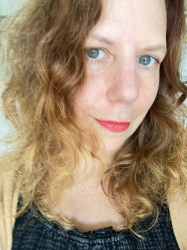
I like to think that Emily might have been standing there across from me at SFMOMA, dressed in her thrifted vintage boy’s shirt (the one she wore to interview for a $10-an-hour job she really needed), holding a notebook she made out of her unpaid electric bills and rubber bands. With pen in hand. With red lipstick on, her mouth in a slight pout, as she puts her thoughts on the page about becoming a woman, about being a woman, about becoming a writer, about being a writer — all smart and wild, not afraid to get up close.
Image by Mark Sayer on unsplash.com, licensed under CC 2.0.