There’s a wooden frame bare of decking
and feet, reaching from my distal limbs
like frail shoots, fresh. Or malignant growth.
You hold the plummet I’ll draw round
the earth and dig. We found this center
by fishing line — braid, and two stones
close apart. The second just for fun.
I shoveled the dirt like sparrows, hungry
and tossing pine needles from the gutter.
Beginning with the mind, every rambling margin
of books read three quarters of the way.
A rock quarry given up without much struggle,
beat down well in graffiti restlessness.
A few stars, the center of town like lightness
sleeping off last night, trying not to suffocate
in the pillow of pulp, pitching sidelong
of our hushed breath. Breathing hushed across
the pulpy fields, loose and wet. Timber in cuts.
This dead hedge begins to cave in over
the washed-white of cement, the footings
lost to yard refuse, lost to slow green so long
we start to feel it deep in our marrow
that this overhang will crumble any moment now.
Click here to read Jayce Elliott on the origin of the poem.
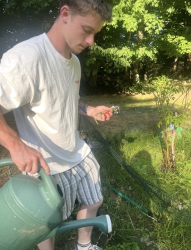
Image by Alfo Medeiros on pexels.com, licensed under CC 2.0.
Jayce Elliott:
To relay the steps of making this poem would be a bore because it came of sitting over a river on the edge of a bridge — that’s it. In my Junior year of undergrad I became increasingly preoccupied with meditation. Simultaneously, a great love for physical labor followed suit. This poem is about this very pruning of the mind, likened to the long and arduous process of building a deck, particularly digging the footings. Before one can track either fresh shoots or malignant growth, there needs to be something beneath, by which you can find your footing among the clutter. In order to build something that lasts, you must first excavate. The poem urges readers to find their center, then dig it out. The fields, loose and wet should call to mind the mind itself. There is nothing more fertile, and if you have no intentionality, the greenery will consume the whole thing. The stream-of-consciousness nature of the lines that follow the finding of the footings should allow the reader to see a wash of images and information, cascading along, out of the hole as the dirt is shoveled. When all the images are past and the deck itself is done, the final stanza reminds us what’s built and cultivated is never final, and the footings themselves soon have no relation to what you have left. In some new way, the process will excavate itself again before the building can begin. That’s where you come in.
Jayce Elliott is a loafer and landscaper in the Northeast where he spends more time outside than in. His poetry appears in New Feathers Anthology, Last Leaves Magazine, The Bridge Journal, where he was also an editor, and elsewhere, including under lots of stones.
Latest posts by Jayce Elliott
(see all)