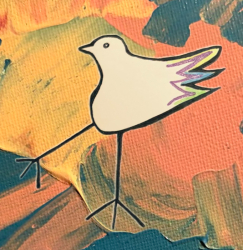
My plague turned eighteen
this year, christened in grade school
trailers, an adult now. If you push
a cowlick in the opposite
direction, it’ll seep out slowly
until it’s flying wires & weird
waves the evangelicals say
don’t align with our values
while I’ve been self-portrait
as who the fuck is the god
of my understanding & how
do I find them, sticking out
my thumb on the side
of the road, doleful quest
that always ends with being
dropped off in the same place
I started. Driving toward ruin
with my own two hands, tearing
my flesh until it splits in a million
sick pieces. My manual labor
is exhaustive work, an honest
living — incorrigible, tearing, tearing,
slacker! The moon was out
at noon, a relic of darkness
rimming the sky & I decided
to be happy that day but couldn’t
remember how to make it
last. One of many rebellions
of my body. Fist shimmying
the plug out of every socket.
Click here to read Anna Drasko on the origin of the poem.
Image by Pierre Goiffon on unsplash.com, licensed under CC 2.0.
Anna Drasko:
The speaker of this poem is dealing with the rebellion of their own body and exploring what it means to be disabled. In the first line, the speaker is struck by the idea that their disability is eighteen years old, and amid this form of rebellion, they are also grappling with rebellion after growing up in a household of manual laborers with strong Christian influences. How does one decide what to take and what to leave behind from their upbringing, family, and religion? What does it mean to search for new ways of understanding the world? The final line of the poem is the speaker accepting that it’s both their own hand rebelling against a restrictive upbringing and their own hand (body) rebelling against itself through illness.
Anna Drasko is a writer living in East Tennessee. Their work appears or is forthcoming in phoebe, Thimble Literary Magazine, Good River Review, Philadelphia Stories, Connecticut River Review, and elsewhere. They hold degrees from the University of Pennsylvania and Penn State.
Latest posts by Anna Drasko
(see all)