


Assuming you do not bounce, the best thing to do after crashing onto the road is to get clear of the next thing coming along.
Seven years ago, driving out of Zion National Park in Utah with Richard, Alex and Ben, friends from medical school, I came upon a man sprawled beneath a switchback, his motorcycle on its side. He’d lost his wheel on a spray of gravel and come down hard. Richard pulled over and switched off the soundtrack to Three Billboards Outside Ebbing, Missouri.
We made a start as best we could. Richard blocked the road with his car to prevent a second accident and called an ambulance. Alex, Ben and I made an assessment. The rider was conscious and not obviously bleeding. He could breathe and had a pulse. He told me he was an emergency medical technician, which accounted for the box which had broken off his bike and cracked open, leaving a stethoscope lying on the tarmac. Ben used it to auscultate the rider’s chest, which admitted and expelled air in the normal way. The driver of a truck behind us announced that he too was a medical technician. He picked a cervical spine collar from his trunk, ducked behind the rider’s head and kept the neck still. Ben continued his examination and found the rider’s right leg to be twisted. It was sore. Ben said the pelvis felt unstable through the leathers. I took my travel towel, damp from the narrows, and improvised of it a pelvic binder, folding and wrapping and twisting the ends together, securing them with tape. I explained to the rider that he may have fractured his pelvis or femur. He expressed concern for the welfare of his bike. Alex and I hauled it upright. The bodywork was torn but it otherwise seemed fine. We wheeled it to the roadside and put up the kickstand. The rider’s face relaxed.
I kept the conversation going — his work, his bike, the canyon. The sandstone around us was scratched red and tan. We heard sirens. Richard cleared the road as the rangers and the ambulance arrived. Ben spoke to the paramedic crew. They cut off his leathers and encased his leg in a splint.
I have no explanation for the agglutination of health professionals on the side of the canyon, nor for the tumbling about us of physicianly gimcracks, save that in the course of human events the world assumes from time to time the properties of a third-rate farce. The appearance on the asphalt of the patient’s stethoscope and our spirited repurposing of my wet towel achieved little beyond giving us something to tamper with until the ambulance arrived. Had the man hit the bullseye of our windshield with his head, or punctured his lung, or snapped his spine like a dried out paperback — in brief, if it had been a large bad thing, then Richard, Alex, Ben and I, for all our time served inside properly equipped hospitals, would have been stumped. Knowing something and being able to do something about it are different things.
We drove away.
***
I have a kind of alacrity in crashing. Thumping into the ground is part of mountain biking. Hospitalisation as a consequence of a two-footed tackle should not be part of football, but these things happen. Taking both hands off a racing bike travelling downhill at night was ill-advised, yes, and of course there was a pot-hole, but what are minor injury units for? Riding a loaded touring bicycle off a switchback in the Dolomites in the snow wasn’t on my itinerary, sure, but it was only an eight-foot drop.
But one Saturday in October, I found another level.
I was in Northumberland in the northeast of England for the wedding of my friend Joe Winstanley. We met working in the Scottish Borders in our first year out of medical school. He showed up to the night shift handover in scrubs with a baseball cap on backwards blaring House of Pain’s “Jump Around” from a handheld speaker and I thought: This is my kind of surgeon. After work we would bolt from the ward to the hospital car park and make for the Tweed valley and ride our mountain bikes through forest and heathland until night fell.
The following year we moved into a shared flat in Edinburgh, a crumbling shanty with a stained glass ceiling in the living room. The window frames were rotten through but Lizzie Wastnedge, our flatmate, insulated the place with her down jackets — a prodigious collection which might have saved the Franklin expedition and whose placement on railings along the walls surely saved our energy bills.
Years passed, our differences multiplied. While cycling in the Lake District I proposed a visit to the Wordsworths’ cottage in Grasmere and Joe replied, “I can tell you all you need to know: It’s a small house with very old wallpaper.” Joe is not bookish but he is warm, basically decent and easily pleased (his spirits can be reliably restored by handing him a pork pie). So when he asked me to be a groomsman at his wedding, I said sure thing.
On the morning of the ceremony, Joe handed me a tailored blue tweed jacket and an orange knit tie to match his own. I put them on and clambered into the back of a rented 1967 Volkswagen camper van with Joe’s parents, two sisters, and Euan Kennedy — driver and urologist.
The van was cream with white leather benches, silver buckets for champagne, and no seat belts. We rattled along country roads and onto the motorway. We made small talk and I tried to remember the outline of my speech for later.
A mile short of the church, on a roundabout, moving around twenty miles an hour, the chatter was replaced with screaming. For the van door had rattled open and I had fallen out.
Calamities seem to happen in slow motion, then very fast. I remember sliding along smooth white leather as the van banked in the turn, then feeling the door give way and swing open, and then falling backwards out of it as though I were a figment in someone else’s dream. My head smashed into the road.
After that there is a gap in my memory.
Joe’s sister Catherine said that as the van drove on she saw me leap from the asphalt to my feet and run off in the direction of a bush, then collapse. Mercifully there was no immediately oncoming traffic, which may have killed me outright. As it was I regained consciousness on the side of the road a short time later. I felt sick, clammy, cold, and embarrassed. I thought: How can this be happening?
Concussion comes from the Latin concutere, meaning to shake or dash together. I thought of the pinkish, folded gel which in its mysteries congeals all my memories and dreams, and how it had been thrust from a moving vehicle onto an English road with nothing to protect it but the back of my skull. I reached behind me and picked out a piece of gravel. Splintered, woozy, and with a dull beast of a headache coming on, I sat up and saw total fear in Joe’s father’s eyes as he ran toward me. I thought: This is not the start Paul envisaged for the morning of his son’s wedding.
I sought to make light of the situation, to chase as many people in the direction of the church as possible. Brain damage due to a head injury comes first from the blow, then from secondary effects of swelling, hypoxia, raised intracranial pressure, and immune mediators. The blow had been struck, and no proportion of Joe’s immediate family remaining on the scene wearing expressions of concern would dull the accretion of chemotactic factors and interleukins lurching through my occipital lobe.
“I’ll be alright, please don’t be late on my account,” I said, dislodging another fleck from my scalp.
Joe’s family were persuaded to head to the church while Euan stayed with me. Since I’d been upended from a van onto my head we agreed I should go to hospital for a check-up.
I was curious to know whether I’d sustained an intracranial haemorrhage. Bleeds on the brain come in five varieties: extradural, subdural, subarachnoid, intracranial and intraventricular — depending on the whereabouts of blood in relation to the membranous linings of the brain and spinal cord, the meninges, or to the matter of the brain itself. A computed tomography scan of my head and neck would help clarify the matter, and would show whether I had broken my neck.
Bleeding inside one’s head is a problem because the wet tofu-textured substance of the brain inhabits a fixed space defined by the craggy bones of the skull. If brain must make room for warm blood, the pressure inside the cranial vault increases. This squeeze restricts the flow of blood to brain which can show up with headache, nausea, reduced consciousness and loss of function in parts of the nervous system. If one is particularly unfortunate, one’s brainstem gets squeezed through a narrow ring at the base of the skull called the foramen magnum. Since the brainstem maintains awareness, blood pressure, breathing and heart rate, if it is squeezed into a conical shape and rammed against a bony tip at the top of the spine called the odontoid process, bad things happen fast. One’s blood pressure rises, heart rate slows, the breath becomes erratic, coma descends. Then you die.
I was aware of this as I lay on the pavement waiting for the ambulance. I felt quite detached, which was pragmatic: either there was a problem or there was not, and no amount of roadside fuss would change it. It was also likely that in considering myself as though I were another patient to be assessed, managed and reassured, I was separating myself from the troublesome reality underneath: You are just a mammal and you’ve whacked your head on a road and maybe you’re finished.
I grew steadily colder. Several cars stopped to offer assistance and one family returned with a blanket and pillow. I wrapped the blanket around me and wondered if anyone had been cared for so well by the people of Northumberland while lying on a roadside dressed in tweeds.
My recumbency lasted longer than was strictly necessary: the ambulance was dispatched to the wrong roundabout. A while later a paramedic arrived in a car and burst out laughing: he had been asked to respond to “an old lady who had collapsed by the side of the road.” Heaven knows what was going on in the ambulance control room.
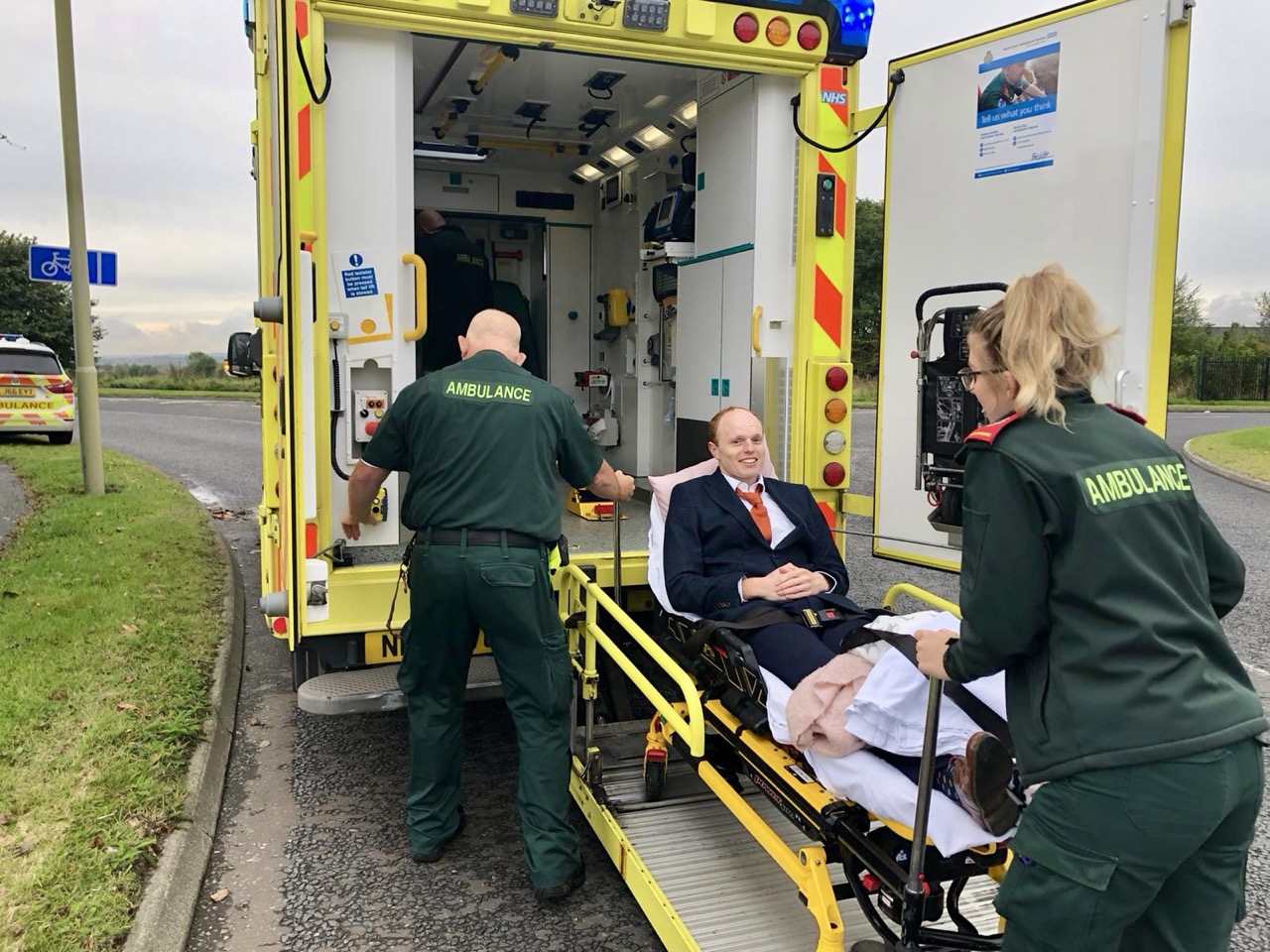
At some point an ambulance arrived. The crew scooped me into a trolley, posted me like an oven tray into the back of their wagon and trundled me to an emergency department outside Newcastle. The doctor requested the scan.
Waiting for the CT, I received a message from Joe’s sister Catherine to say they had been praying for me. What she meant was that the entire wedding had been held up by a prayer from the minister:
“For those who cannot be with us. Especially Dr. Adam Boggon, who was hospitalized on his way to the ceremony. We understand he is in a serious condition but that he is in the right place….”
I lay on my back in the scanner. It is sometimes observed that there are two types of doctors: those who study every disease and conclude that they have it, and those who assume that because they know pathology, they are invulnerable to it. Both positions are insane. I incline toward the latter. This is in part because I’ve admitted patients to hospital for years and know that most hospital doctors are defensive and risk-averse, so request large numbers of tests even when the prior probability of a positive finding is low. As a consequence I have seen hundreds of CT scans ordered after head injuries, and barely a fistful of major bleeds. Admittedly I had never seen a patient ejected sideways out of a retro camper van. I chose not to dwell on that.
I lay very still inside the tube. The folded knapsack of matter white, grey, black and red which by some concatenation spun all my thoughts was fixed for an instant by spinning x-rays and woven to three-dimensions scrollable on the radiologist’s computer screen.
There was no bleed. I was deemed fit to go. Euan put me in a taxi. We made for the reception.
Half an hour later I entered the barn where the party was held. The tables were immaculate and merrily lit. Huddles of gaily clad men, women and children bunched like clover. I walked slowly through the wide door, my face pallid, my jacket ripped, bits of grit still embedded in the back of my head. There was a smattering of applause. Lizzie gave me a hug.
We are drawn to the blood, since bleeding can be drilled or coiled or cut at by surgeons. Yet the 69 million or so people who sustain traumatic brain injuries each year are more likely to walk off with a concussion that a ticket to neurosurgery. Concussion can throw up a working party of symptoms: headache, tiredness, vertigo, blurry vision, memory problems, personality changes, insomnia, imbalance, a feeling of being stunned. The list continues, and proceeds to dementia. Which is unsurprising since the brain is so vulnerable and contains so much. There is no knowing whether this head injury will come back to me later in life, and it is easier to live in the absence of such knowledge.
My speech could not ignore my morning’s exploration of physical comedy, but I didn’t want to distract attention from Joe and Emma. I shambled to my feet, dusted my ragged tweeds, and explained that I’d felt nervous about speaking before a room of strangers so had tossed myself from the van to necessitate a visit to the local hospital, thereby evading my responsibility. Since they had concluded I was fine, I realized the game was up: I’d have to give my speech anyway. I said it was a pleasure to be there.
It was.
After a crash: First, get to a safe place and sit down. Then survey the wreck, applying the principle of triage: I’m fine; or, this hurts, but I can walk it off; or, oh dear, this is a large bad thing — time to call for professional help and/or a masked vigilante. Later, once bones are set, cast removed, scars agleam, comes the part that no one else can do but you: Get back on your feet, bike, horse, skateboard, chariot — whatever moves you — and press on down the road. For keeping going matters so much more than having fallen down.
Photo courtesy of Adam Boggon.
- How to Crash - April 18, 2026
- Swimming in an Asylum - October 26, 2024
“I thought of the pinkish, folded gel which in its mysteries congeal all my memories and dreams”
The subject of the dependent clause is gel—the gel “congeals all,” not “congeal.” It’s not the “mysteries” congealing anything, since they are embedded in a prepositional phrase. Maybe get the gel to work on basic syntax.
Wires crossed in the editing process–thx for pointing out!